Designing Multi-Peptide Research Protocols: A Systematic Approach
As peptide research grows more sophisticated, scientists are increasingly designing multi-compound studies that examine combinations of peptides acting through complementary mechanisms. Whether investigating growth hormone axis modulation, immune signaling networks, or neuroprotective pathways, effective peptide research protocol design requires careful planning across multiple dimensions – from compound selection and compatibility to dosing frameworks and analytical endpoints.
Aureum Peptides offers curated protocol bundles designed by research scientists, alongside individual compounds for custom study designs.
Step 1: Define Your Research Question
Every strong protocol begins with a clearly articulated hypothesis. In multi-peptide research, this means specifying:
- Primary endpoint: What measurable outcome will determine success or failure? (e.g., telomerase activity, GH secretion kinetics, cytokine profile changes)
- Secondary endpoints: What additional data points will provide mechanistic insight?
- Rationale for combination: Why study these specific peptides together? Is the hypothesis complementary in scope, additive, or comparative?
- Model system suitability: Does your chosen experimental model (cell line, tissue explant, etc.) express the relevant receptors and pathways?
Step 2: Compound Selection and Compatibility
Not all peptides are compatible in the same experimental system. Key considerations include:
Buffer compatibility: Different peptides may require different pH ranges for stability. GHK-Cu requires avoiding chelating agents, while some peptides need slightly acidic conditions. Plan your vehicle and media composition to accommodate all compounds.
Concentration ranges: Published effective concentrations vary enormously between peptides – from picomolar (some growth factors) to micromolar (many synthetic peptides). Ensure your dosing framework is appropriate for each compound.
Temporal considerations: Some peptides act within minutes (secretagogues), while others require hours or days of exposure (gene expression modulators). Design your treatment schedule to capture each compound relevant window of activity.
Physical interactions: At high concentrations, some peptides may aggregate or interact with each other in solution. When possible, add compounds sequentially rather than pre-mixing, and verify stability of combinations.
Step 3: Controls and Experimental Design
Rigorous multi-peptide studies require more extensive controls than single-compound experiments:
- Vehicle control: Matched to the reconstitution vehicle for all compounds
- Individual compound controls: Each peptide tested alone at experimental concentration
- Combination groups: The multi-peptide conditions being investigated
- Positive controls: Known activators of your target pathways
- Dose-response: At minimum, test 3 concentrations of each compound to establish dose-dependency
- Biological replicates: Minimum n=3 independent experiments for statistical validity
For a two-peptide study with three doses each, the complete matrix includes: 1 vehicle control + 3 doses of peptide A + 3 doses of peptide B + 9 combination conditions (3×3) + positive controls = minimum 17 conditions per experiment. Plan your throughput accordingly.
Step 4: Timeline and Endpoint Planning
Map your experimental timeline before beginning:
Acute studies (minutes to hours): Appropriate for signaling pathway activation, secretagogue effects, phosphorylation cascades. Typical endpoints: Western blot, ELISA, real-time reporter assays.
Short-term studies (1-7 days): Suitable for gene expression changes, proliferation assays, wound healing scratch assays. Typical endpoints: qPCR, flow cytometry, imaging.
Long-term studies (weeks to months): Required for differentiation studies, telomere length changes, chronic exposure effects. Typical endpoints: specialized assays (TRAP, FISH), histological analysis.
Step 5: Compound Management and Quality Control
Multi-peptide protocols amplify the importance of proper compound management:
- Reconstitute each peptide according to its specific requirements (check product documentation)
- Prepare stock solutions at 10-100x working concentration to minimize vehicle volume in cultures
- Aliquot into single-use portions – never repeatedly freeze-thaw stock solutions
- Verify compound identity and purity using COA documentation before beginning experiments
- Record lot numbers for all compounds used – essential for reproducibility
- Include stability controls: test a sample of your working solutions at the end of the experiment to confirm compound integrity throughout
Pre-Built Protocol Bundles
Aureum Peptides offers scientifically designed protocol bundles that pair complementary peptides for common research paradigms:
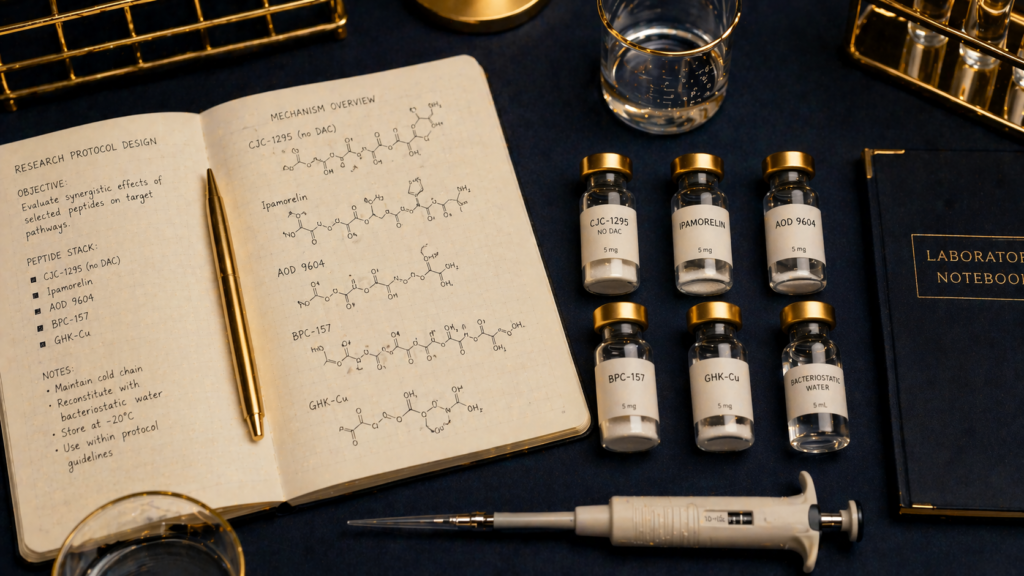
- GH Axis Research Bundle: CJC-1295 + Ipamorelin for growth hormone axis research
- Aging Research Protocol: Epitalon + complementary compounds for aging research
- Immunology Research Bundle: Thymosin Alpha-1 based combinations for immunology studies
- Neuropeptide Research Bundle: Semax + Selank for neuroscience research
- Dermatological Research Bundle: GHK-Cu based combinations for dermatological studies
Each bundle includes compound-specific handling documentation and suggested starting frameworks based on published literature. For custom study designs, use our Bundle Builder to create personalized research compound sets.
Documentation and Reproducibility
Finally, document everything. Multi-peptide studies are inherently complex, and thorough records are essential for troubleshooting, replication, and publication. Record compound sources, lot numbers, reconstitution details, storage conditions, treatment schedules, and any deviations from your planned protocol. Verify all compound batches through our COA verification portal.
Disclaimer: All products sold by Aureum Peptides are intended for laboratory and research use only. Not for human consumption. No statements on this page have been evaluated by the FDA. These products are not intended to diagnose, treat, cure, or prevent any disease. For Research Use Only.