
Bioavailability Challenges in Peptide Research: Understanding Enzymatic Degradation
One of the most significant variables in peptide research is the rapid degradation that peptides undergo when exposed to biological systems. Unlike small-molecule compounds that may persist for hours in biological matrices, most unmodified peptides are cleaved by endogenous enzymes within minutes. Understanding these proteolytic degradation pathways is essential for designing rigorous research protocols and interpreting experimental results accurately.
This article reviews the major enzymatic mechanisms responsible for peptide instability in biological systems, the structural strategies that have been studied to improve peptide stability, and how these factors influence research compound selection in laboratory settings.
Why Peptides Have Short Half-Lives in Biological Systems
The mammalian body maintains an extensive array of proteolytic enzymes designed to process dietary proteins, regulate signaling peptides, and clear damaged proteins. These same enzymes represent a formidable barrier to exogenous peptides introduced in research systems. As reviewed by Werle and Bernkop-Schnurch (2006), peptide degradation occurs at multiple biological sites:
- Circulatory system: Soluble peptidases in plasma rapidly cleave susceptible bonds
- Tissue surfaces: Membrane-bound enzymes on endothelial and epithelial cells
- Intracellular compartments: Lysosomal and cytoplasmic proteases degrade internalized peptides
- Organ-specific metabolism: The liver and kidneys contain high concentrations of degradative enzymes
The result is that most linear, unmodified peptides exhibit half-lives measured in single-digit minutes in preclinical models, a fundamental parameter that researchers must account for in experimental design.
Major Proteolytic Degradation Pathways
Several enzyme families are primarily responsible for peptide degradation in biological research systems. Understanding which enzymes target specific structural features allows researchers to predict degradation patterns for a given peptide sequence.
Dipeptidyl Peptidase IV (DPP-IV)
DPP-IV is a serine protease that cleaves dipeptides from the N-terminus of peptides containing a proline or alanine residue at position 2. This enzyme is particularly relevant to research involving:
- GLP-1 analogs and incretin-related peptides
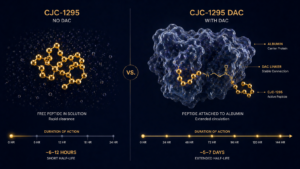
- GHRH analogs such as CJC-1295 (Mod GRF 1-29)
- Many naturally occurring regulatory peptides with Ala or Pro at position 2
DPP-IV is widely distributed in biological systems, present both as a membrane-bound form on cell surfaces and as a soluble form in plasma, making it one of the most significant degradation enzymes encountered in peptide research (Fosgerau & Hoffmann, 2015).
Neutral Endopeptidase (NEP / Neprilysin)
NEP is a zinc-dependent metalloprotease that cleaves peptides at the amino side of hydrophobic residues. It has broad substrate specificity and degrades numerous bioactive peptides in preclinical model systems. NEP is membrane-bound and highly expressed in kidney, lung, and brain tissue, making it relevant to research involving peptides that interact with these organ systems.
Aminopeptidases
This family of enzymes removes single amino acids sequentially from the N-terminus of peptide chains. Aminopeptidase N (APN/CD13) is among the most studied members and exhibits broad specificity for N-terminal residues. In preclinical models, aminopeptidases contribute to the progressive shortening and inactivation of many research peptides (Werle & Bernkop-Schnurch, 2006).
Carboxypeptidases
The C-terminal counterparts to aminopeptidases, carboxypeptidases remove residues from the carboxy terminus of peptides. These enzymes are abundant in blood plasma and contribute to the degradation of peptides that have already been partially processed by endopeptidases.
Structural Strategies Studied to Improve Stability
The research community has developed and investigated numerous structural modifications intended to reduce enzymatic susceptibility. Understanding these approaches is important for researchers selecting among available compound formats for their laboratory investigations.
PEGylation
The covalent attachment of polyethylene glycol (PEG) chains to peptides is one of the most extensively studied stabilization strategies. As reviewed by Di (2015), PEGylation can extend peptide persistence in biological systems through multiple mechanisms:
- Steric shielding: The PEG moiety physically blocks access of proteases to cleavage sites
- Increased hydrodynamic radius: PEGylated peptides exceed renal filtration thresholds, reducing clearance
- Reduced immunogenicity: The PEG shield can decrease immune recognition in preclinical models
Cyclization
Converting a linear peptide to a cyclic structure eliminates free N- and C-termini, immediately removing susceptibility to amino- and carboxypeptidases. Cyclization also constrains the peptide backbone, often making internal cleavage sites less accessible to endopeptidases. Fosgerau and Hoffmann (2015) noted that cyclic peptide formats have gained significant research interest due to their improved stability profiles in preclinical model systems.
D-Amino Acid Substitution
Replacing one or more L-amino acids with their D-enantiomers at protease-susceptible positions can dramatically reduce enzymatic degradation. Most mammalian proteases exhibit strong stereoselectivity for L-amino acid substrates, and the introduction of even a single D-residue at a critical position can substantially increase resistance to cleavage. This approach must be balanced against potential changes in biological activity, as the altered stereochemistry may affect target interactions.
N-Terminal and C-Terminal Modifications
Simple chemical modifications to the peptide termini can significantly reduce degradation by exopeptidases:
- N-terminal acetylation: Blocks aminopeptidase recognition
- C-terminal amidation: Reduces carboxypeptidase susceptibility and is present in many naturally occurring bioactive peptides
Albumin-Binding Strategies
Diao and Bhatt (2020) reviewed approaches that leverage binding to endogenous albumin as a strategy for extending peptide persistence in preclinical models. These include fatty acid conjugation (as seen in certain GLP-1 analogs) and albumin-binding domain technology. The Drug Affinity Complex (DAC) used in CJC-1295 DAC represents another albumin-binding approach relevant to peptide research.
Relevance to Research Compound Selection
Understanding degradation pathways directly influences how researchers select and work with peptide compounds in laboratory settings. Key considerations include:
- Modified vs. unmodified formats: When both are available, the choice between a native-sequence peptide and a stabilized analog depends on the research question being addressed
- In vitro vs. in vivo model systems: Degradation is far less significant in cell culture studies using serum-free media than in whole-animal preclinical models
- Protease inhibitor cocktails: Adding appropriate protease inhibitors to biological samples can preserve peptides for analysis but may confound certain experimental endpoints
- Administration timing in preclinical protocols: Short half-life peptides may require repeated or continuous administration protocols to maintain effective research concentrations
Researchers can explore both native-sequence and modified peptide formats at Aureum Peptides, selecting the appropriate compound for their specific research requirements.
Measuring Degradation in Research Settings
Quantifying peptide stability is a standard component of research protocol development. Common approaches include:
- Plasma stability assays: Incubating the peptide in plasma or serum at physiological temperature and measuring remaining intact peptide over time by LC-MS
- Microsomal stability assays: Using liver microsomes to assess hepatic degradation potential
- Brush border membrane vesicle assays: Evaluating degradation by intestinal enzymes, relevant to oral peptide research
- Recombinant enzyme assays: Testing susceptibility to individual proteases (DPP-IV, NEP, etc.) to identify specific cleavage sites
These stability assessments provide essential data for research protocol design and are considered standard practice in preclinical peptide research (Di, 2015).
References
- Di, L. (2015). Strategic approaches to optimizing peptide ADME properties. AAPS Journal, 17(1), 134-143.
- Diao, L. & Bhatt, D.K. (2020). Pharmacokinetic properties of biologics. Drug Metabolism and Disposition, 48(11), 1157-1167.
- Fosgerau, K. & Hoffmann, T. (2015). Peptide therapeutics: Current status and future directions. Drug Discovery Today, 20(1), 122-128.
- Werle, M. & Bernkop-Schnurch, A. (2006). Strategies to improve plasma half life time of peptide and protein drugs. Amino Acids, 30(4), 351-367.
Disclaimer: All products sold by Aureum Peptides are intended for laboratory and research use only. Not for human consumption. All peptides referenced in this article are sold as research chemicals. No statements on this page have been evaluated by the FDA. This product is not intended to diagnose, treat, cure, or prevent any disease. For Research Use Only.