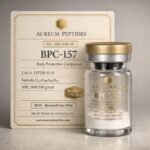

BPC-157
Body Protection Compound-157, Bepecin, PL 14736, PL-10
| Quantity | Discount | Price Each |
|---|---|---|
| 1 | — | $22.50 |
| 2+ | Save 5% | $21.38 |
| 3+ | Save 10% | $20.25 |
| 5+ | Save 15% | $19.13 |


Estimated delivery: Apr 21 – Apr 24
Standard delivery: Apr 22 – Apr 24 | Express: Apr 20 – Apr 21
Quality & Transparency
Every batch tested. Every result published. No exceptions.
BPC-157 (Body Protection Compound-157) is a synthetic pentadecapeptide derived from a partial sequence of human gastric juice protein BPC. It consists of 15 amino acids and has been the subject of extensive preclinical research regarding tissue protection and repair mechanisms. BPC-157 has demonstrated stability in human gastric juice, distinguishing it from many other peptides that undergo rapid degradation in acidic environments.
BPC-157 is a stable gastric pentadecapeptide with a molecular weight of 1419.53 g/mol. Unlike many bioactive peptides, BPC-157 demonstrates remarkable stability in gastric juice at physiological pH. The peptide's stability profile is attributed to its unique amino acid composition, which resists enzymatic degradation by pepsin and other gastric proteases.
Structurally, BPC-157 contains no disulfide bonds and maintains its conformation across a wide pH range (2-10), a property that has made it particularly interesting for in vitro stability studies.
Published preclinical research on BPC-157 has explored its effects in multiple experimental models:
• Gastrointestinal biology: Studies in animal models have examined BPC-157's effects on gastric mucosal integrity, intestinal anastomosis healing, and inflammatory bowel models (Sikiric et al., 2018).
• Musculoskeletal biology: Preclinical investigations have assessed BPC-157 in tendon, ligament, and muscle injury models, examining parameters such as collagen fiber organization and biomechanical strength (Chang et al., 2011).
• Vascular biology: Research has explored BPC-157's interaction with the NO system and angiogenic pathways in various tissue repair models (Hsieh et al., 2017).
• Neuroprotective research: Studies have investigated BPC-157 in models of peripheral nerve injury and dopaminergic system modulation (Klicek et al., 2013).
BPC-157 research has identified several molecular pathways of interest:
• FAK-paxillin pathway: BPC-157 activates focal adhesion kinase (FAK) and downstream paxillin phosphorylation in fibroblast migration models, promoting directional cell movement toward wound sites.
• VEGF/NO system: BPC-157 upregulates vascular endothelial growth factor (VEGF) and interacts with nitric oxide synthase (NOS) pathways. In vessel-occluded models, BPC-157 promoted NO-mediated vasodilation and angiogenesis.
• Growth hormone receptor: BPC-157 upregulated GH receptor expression in hepatocyte models, potentially amplifying endogenous GH signaling cascades (JAK2/STAT5).
• JAK-2/STAT-3 signaling: In inflammatory bowel models, BPC-157 modulated JAK-2/STAT-3 signaling, reducing pro-inflammatory cytokine production.
• Dopaminergic system: Studies demonstrated BPC-157 interaction with dopamine D2 receptor pathways and modulation of catecholamine turnover in brain tissue.
These pathway interactions have been characterized primarily in rodent models and cell culture systems. Translation to human biology has not been established.
Key preclinical findings with published concentration ranges:
Sikiric et al. (2018): Accelerated healing in rat gastric ulcer models at µg/kg doses. Reduced ulcer area by 68% vs controls at day 7. Mechanism linked to NO system activation and enhanced granulation tissue formation.
Chang et al. (2011): Enhanced tendon-to-bone healing in rat rotator cuff model. BPC-157 at 10 µg/kg improved collagen fiber organization and ultimate load to failure by 43% at 8 weeks. Type I/III collagen ratio significantly improved.
Hsieh et al. (2017): Increased VEGF expression (2.3-fold) and capillary density (1.8-fold) in rat muscle crush injury model. Effective concentration range: 2-10 µg/mL in cell culture; 10 µg/kg in vivo.
Klicek et al. (2013): Improved colitis scores in DSS-induced rat colitis model. BPC-157 at 10 µg/kg reduced inflammatory infiltrate and preserved mucosal architecture.
Typical in vitro concentrations: 0.1-100 µM (validated across multiple cell types including fibroblasts, endothelial cells, and epithelial cells).
All findings are from animal studies. No controlled human clinical trials have been completed or published.
Form: Lyophilized powder, 5mg per vial
Appearance: White to off-white powder
Molecular Weight: 1419.53 g/mol
Reconstitution Guide:
- For 1 mg/mL stock: Add 5.0 mL bacteriostatic water to 5mg vial
- For 500 µg/mL: Add 10.0 mL bacteriostatic water
- For 250 µg/mL: Add 20.0 mL bacteriostatic water
- Gently swirl until dissolved (do not vortex)
Solubility: Freely soluble in water (>10 mg/mL), bacteriostatic water, PBS (pH 7.4), and saline. Stable across pH 2-10. No organic co-solvent required.
Stability: Lyophilized powder stable 24 months at -20°C. Reconstituted solution stable 30 days at 2-8°C. Tolerates up to 3 freeze-thaw cycles with <5% degradation (HPLC verified).Analytical Testing: HPLC purity (≥99%), ESI-MS identity confirmation, LAL endotoxin (<0.1 EU/mg), USP sterility, amino acid analysis. Full COA provided per batch.
This content was prepared for informational purposes based on published preclinical research. It does not constitute medical advice or product efficacy claims.
- 1Sikiric P, et al. "Stable gastric pentadecapeptide BPC 157-NO-system relation." Curr Pharm Des. 2014;20(7):1126-35. PubMed: 23755727 PubMed
- 2Chang CH, et al. "The promoting effect of pentadecapeptide BPC 157 on tendon healing involves tendon outgrowth, cell survival, and cell migration." J Appl Physiol. 2011;110(3):774-80. PubMed: 21030672 PubMed
- 3Hsieh MJ, et al. "Therapeutic potential of pro-angiogenic BPC157 is associated with VEGFR2 activation and up-regulation." J Mol Med. 2017;95(3):323-33. PubMed: 27599809 PubMed
- 4Klicek R, et al. "Stable gastric pentadecapeptide BPC 157 heals cysteamine-colitis and colon-colon-anastomosis and counteracts cuprizone brain demyelination." J Physiol Pharmacol. 2013;64(5):597-612. PubMed: 24304574 PubMed
- 5Seiwerth S, et al. "BPC 157 and standard angiogenic growth factors: Gastrointestinal tract healing, lessons from tendon, ligament, muscle and bone healing." Curr Pharm Des. 2018;24(18):1972-89. PubMed: 29737246 PubMed
Advancing Research, One Peptide at a Time
Premium quality. Rigorous testing. Trusted by researchers worldwide.
| Test | Target | Result |
|---|---|---|
| HPLC Purity | u226598.0% | 99.2% ✓ |
| Mass Spectrometry | 1419.5 u00b1 1.0 Da | 1419.5 Da ✓ |
| Endotoxin (LAL) | <0.1 EU/mg | <0.05 EU/mg ✓ |
| Sterility (USP <71>) | No growth | Pass ✓ |
| Appearance | White powder | Conforms ✓ |
Temperature
Lyophilized: -20°C, protected from light
Reconstituted: 2-8°C
Shelf Life
24 months lyophilized at -20°C
30 days reconstituted at 2-8°C
Handling
Allow vial to reach room temperature before opening.
Reconstitute with bacteriostatic water.
Avoid repeated freeze-thaw cycles.
Frequently Asked Questions
Stay at the Forefront
Join our research community. Get early access to new peptides, exclusive member pricing, and curated literature reviews delivered to your inbox.
Welcome to the Circle ✦
Check your inbox for your 10% welcome discount

Frequently Studied Together

BPC-157
Price range: $22.50 through $37.00
This itemResearch Compound Comparison
Side-by-side analysis of chemical profiles, research applications, and specifications