Certificate of Analysis for Peptides: Your Quality Verification Guide
A Certificate of Analysis (COA) is the most important document accompanying any research peptide purchase. For researchers working with a certificate of analysis for peptides, understanding what each section means – and what red flags to watch for – is essential for maintaining experimental integrity and reproducible results.
Aureum Peptides provides comprehensive COAs for every batch. You can verify any COA online using your batch number.
What is a Certificate of Analysis?
A COA is an official document issued by a testing laboratory that certifies the identity, purity, and quality characteristics of a specific batch of a chemical compound. For peptides, the COA serves as proof that the product you received matches the product description and meets specified quality standards.
Think of a COA as the peptide equivalent of a vehicle inspection report – it tells you whether the compound is safe and suitable for its intended research use based on objective analytical measurements.
Key Sections of a Peptide COA
1. Product Identification
The header section should include:
- Peptide name and sequence: The full amino acid sequence using standard one-letter or three-letter codes
- Molecular formula and weight: The theoretical molecular formula and calculated molecular weight
- Batch/Lot number: A unique identifier linking this COA to your specific vial
- Manufacturing date: When the peptide was synthesized
- Quantity: Amount in the container (typically in milligrams)
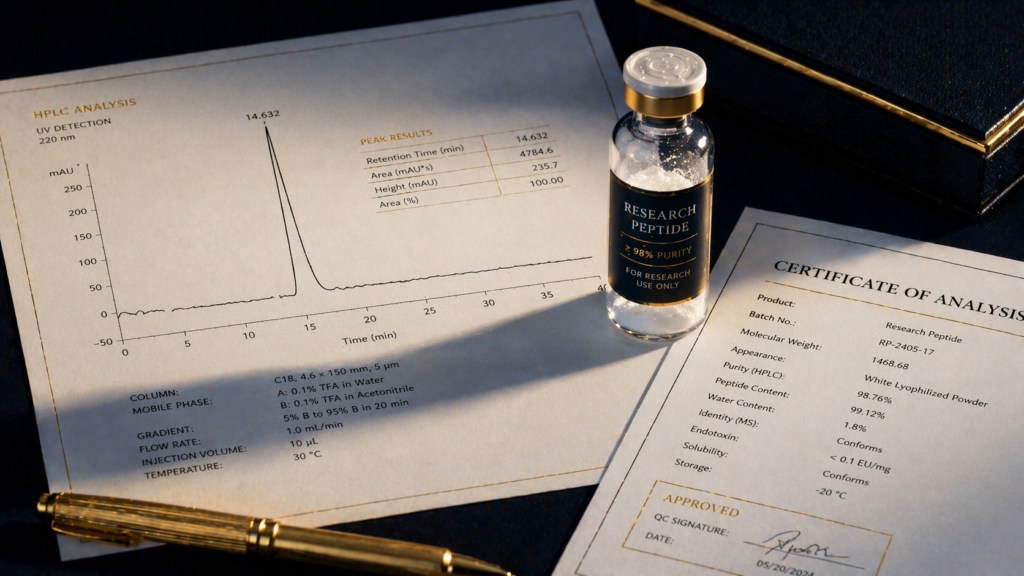
2. HPLC Purity Analysis
This is the most critical section. Look for:
- Purity percentage: Should be 99%+ for publication-quality research (Aureum standard)
- Chromatogram: The actual HPLC trace showing peaks – a single dominant peak indicates high purity
- Method details: Column type (usually C18), mobile phase composition, gradient conditions, and UV detection wavelength (typically 214nm or 220nm)
- Retention time: When the main peak eluted from the column
3. Mass Spectrometry Data
Mass spec confirms identity:
- Observed molecular weight: Should match the theoretical MW within instrument tolerance (typically +/- 0.1 Da for ESI-MS)
- Spectrum: The mass spectrum showing the molecular ion peak and charge state distribution
- Ionization method: Usually ESI (Electrospray Ionization) or MALDI-TOF
4. Appearance and Physical Properties
The COA should describe the physical form (typically white to off-white lyophilized powder), solubility characteristics, and any relevant physical observations.
5. Additional Testing (When Applicable)
- Amino acid analysis: Confirms correct amino acid composition and ratios
- Water/moisture content: Measured by Karl Fischer titration
- Counterion content: TFA or acetate salt form specification
- Endotoxin levels: Bacterial endotoxin testing results
Red Flags on a COA
Watch for these warning signs that indicate potential quality issues:
- No chromatogram included: A purity number without supporting data cannot be verified
- Purity below 95%: May indicate inadequate purification or degradation
- Mass spec mismatch: Observed MW deviating more than 1 Da from theoretical suggests wrong product
- Missing batch number: Cannot trace quality data back to your specific product
- Generic or template appearance: All COAs looking identical regardless of product
- No testing laboratory identified: Reputable suppliers identify the testing facility
Verifying Your COA with Aureum Peptides
Every Aureum Peptides product ships with a batch-specific COA. You can also access and verify your COA digitally through our online verification portal. Simply enter your batch number to view the complete analytical data package, including HPLC chromatograms and mass spectra.
This level of transparency is our commitment to supporting rigorous, reproducible research.
Disclaimer: All products sold by Aureum Peptides are intended for laboratory and research use only. Not for human consumption. No statements on this page have been evaluated by the FDA. This product is not intended to diagnose, treat, cure, or prevent any disease. For Research Use Only.