
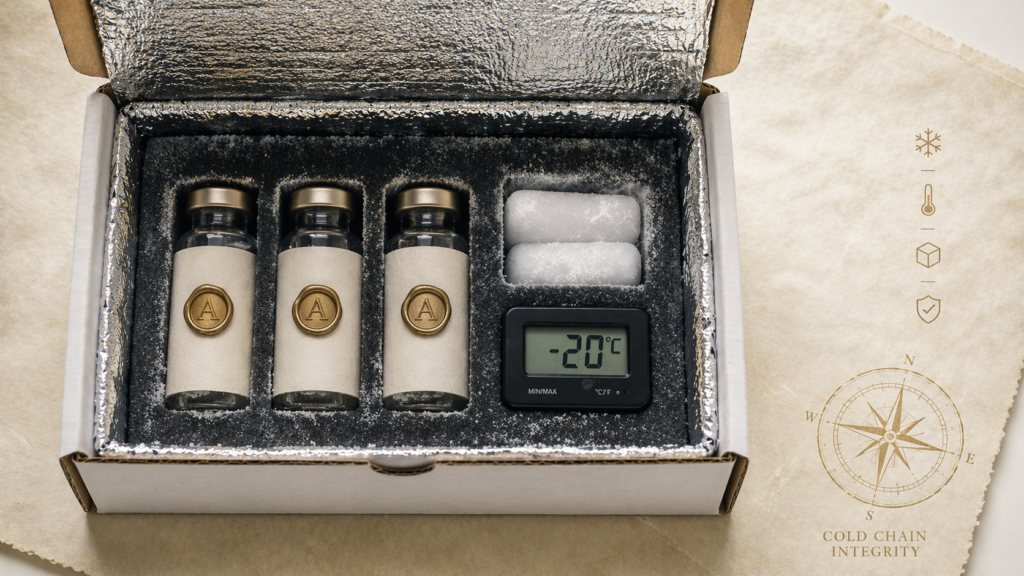
The Importance of Temperature Control in Peptide Distribution
The journey from synthesis laboratory to research bench is a critical phase in the peptide supply chain. Temperature excursions during shipping can compromise peptide integrity, reduce effective purity, and undermine the reproducibility of downstream experiments. Understanding cold chain logistics, the systems and processes that maintain temperature control during transport, helps researchers evaluate supplier quality and protect their research investments.
Temperature Sensitivity of Synthetic Peptides
Synthetic peptides vary widely in their thermal stability, but all are subject to accelerated degradation at elevated temperatures. The Arrhenius relationship predicts that chemical reaction rates approximately double for every 10-degree Celsius increase in temperature, meaning that a peptide exposed to 40 degrees Celsius during summer transit may degrade at four times the rate compared to controlled storage at 20 degrees Celsius.
Specific degradation concerns during shipping include accelerated deamidation of asparagine residues, oxidation of methionine and cysteine-containing sequences, increased hydrolysis rates at labile peptide bonds, and aggregation of certain sequences in the presence of heat and moisture. The severity of these effects depends on the specific sequence, the magnitude and duration of the temperature excursion, and the formulation (lyophilized vs. solution) of the shipped product (Manning et al., 2010, Pharmaceutical Research, 27(4), 544-575).
Lyophilized vs. Solution Shipping
The physical form of the peptide during shipping significantly impacts its vulnerability to temperature-induced degradation:
Lyophilized (freeze-dried) peptides are inherently more stable during transit. The absence of water dramatically slows hydrolytic and oxidative degradation pathways. Lyophilized peptides can generally tolerate brief temperature excursions of up to 30-37 degrees Celsius without significant degradation, provided they remain sealed and protected from moisture. This is the standard shipping form for Aureum Peptides products.
Solution-phase peptides are far more vulnerable during shipping. Water facilitates virtually all chemical degradation reactions, and temperature fluctuations can accelerate these processes dramatically. Solution-phase peptides require strict cold chain maintenance and should be shipped on dry ice or with validated cold packs.
The preference for lyophilized shipping is well-established in the peptide research supply industry, as it provides a buffer against the inevitable temperature variations encountered during ground and air transport (Carpenter & Chang, 1996, Pharmaceutical Research, 13(2), 168-175).
Packaging Methods and Thermal Protection
Effective cold chain packaging employs multiple layers of thermal protection to maintain acceptable temperatures throughout the shipping duration:
Insulated containers: Expanded polystyrene (EPS) foam or polyurethane insulated boxes provide the primary thermal barrier. The thickness and density of the insulation determine the duration of temperature maintenance. High-performance insulated shippers can maintain internal temperatures for 48-96 hours depending on ambient conditions.
Cold packs and gel packs: Phase-change materials that absorb heat as they transition from solid to liquid states. For peptide shipping, refrigerant gel packs (2-8 degrees Celsius) are most commonly used. The number and placement of packs are calibrated to the shipper volume, expected transit time, and seasonal temperature profiles.
Dry ice: Solid carbon dioxide (-78.5 degrees Celsius) provides the most aggressive cooling for ultra-cold shipments. Dry ice is used when shipping peptide solutions, compounds with known thermal instability, or when transit times exceed the duration of gel pack efficacy. However, dry ice shipments require hazardous materials classification and special handling documentation.
Temperature monitors: Data loggers or chemical indicator strips placed inside the package provide a record of the temperature history during transit. These devices allow both the shipper and receiver to verify that conditions remained within acceptable limits (Bishara, 2006, PDA Journal of Pharmaceutical Science and Technology, 60(5), 337-345).
Seasonal Considerations
Shipping risk profiles change dramatically with the seasons and geographic routes. Summer months pose the greatest challenge, with ambient temperatures in transit vehicles, loading docks, and aircraft cargo holds potentially exceeding 40 degrees Celsius. Winter shipping in cold climates introduces the opposite risk, as freezing temperatures can cause physical damage to formulations and, in the case of solution-phase products, freeze-thaw stress.
Responsible suppliers adjust their packaging protocols seasonally, increasing cold pack quantities or switching to dry ice during summer months, and adding insulation against freezing during winter. Shipping days are also strategically selected to avoid weekend holds at distribution hubs, where packages may sit in uncontrolled environments for extended periods.
Last-Mile Considerations
The final leg of delivery, from the local distribution center to the laboratory, is often the most vulnerable segment of the cold chain. Packages left on loading docks, in mailrooms, or at building entrances may be exposed to ambient temperatures for hours before being retrieved and placed in proper storage.
Researchers can mitigate last-mile risk by providing specific delivery instructions (e.g., “deliver to laboratory, Building X, Room Y”), designating a responsible recipient, arranging for signature-required delivery to ensure someone is present, and immediately transferring received packages to appropriate storage upon arrival. Checking temperature indicator strips or data loggers upon receipt provides confirmation that the cold chain was maintained throughout transit.
Evaluating Supplier Cold Chain Practices
When selecting a peptide supplier, cold chain capabilities should be a key evaluation criterion alongside product quality and pricing. Important questions to consider include whether the supplier uses validated insulated packaging systems, whether temperature monitoring is included with shipments, how packaging protocols are adjusted for seasonal conditions, what the supplier policy is for products that arrive with documented temperature excursions, and whether the supplier offers expedited shipping options for temperature-sensitive compounds.
Aureum Peptides employs validated cold chain packaging and shipping protocols designed to maintain product integrity from warehouse to laboratory, with all products shipped in lyophilized form to maximize transit stability (Hanson et al., 2015, Journal of Pharmaceutical Sciences, 104(2), 293-300).
What to Do if Cold Chain is Compromised
If a package arrives with evidence of temperature excursion (warm to the touch, melted gel packs, temperature indicator tripped), researchers should document the condition of the package upon receipt with photographs, note the time between delivery and retrieval, check any included temperature monitoring devices and record the data, contact the supplier immediately to report the issue, and store the product at recommended conditions pending resolution.
Lyophilized peptides that experienced brief, moderate temperature excursions may still be suitable for use, but analytical verification (HPLC and MS) is recommended before commencing experiments with potentially compromised material (Bhatnagar et al., 2007, Pharmaceutical Development and Technology, 12(5), 505-523).
Conclusion
Cold chain logistics are an often-overlooked but critical component of peptide research quality. The integrity of research-grade compounds depends not only on manufacturing and analytical quality but also on the conditions maintained during storage and transport. By understanding temperature sensitivity, packaging technologies, and last-mile risks, researchers can make informed supplier selections and implement receiving protocols that protect the quality of their research materials from synthesis through experimental use.
For research use only. Not for human consumption.