The Role of the Certificate of Analysis in Research Procurement
A Certificate of Analysis (COA) is the primary quality documentation accompanying research-grade peptides and chemical compounds. It provides analytical verification that a product meets its stated specifications, serving as the foundational quality record for any rigorous research program. Understanding how to read and evaluate a COA is an essential competency for researchers procuring synthetic peptides for laboratory investigation.
Core Components of a Peptide COA
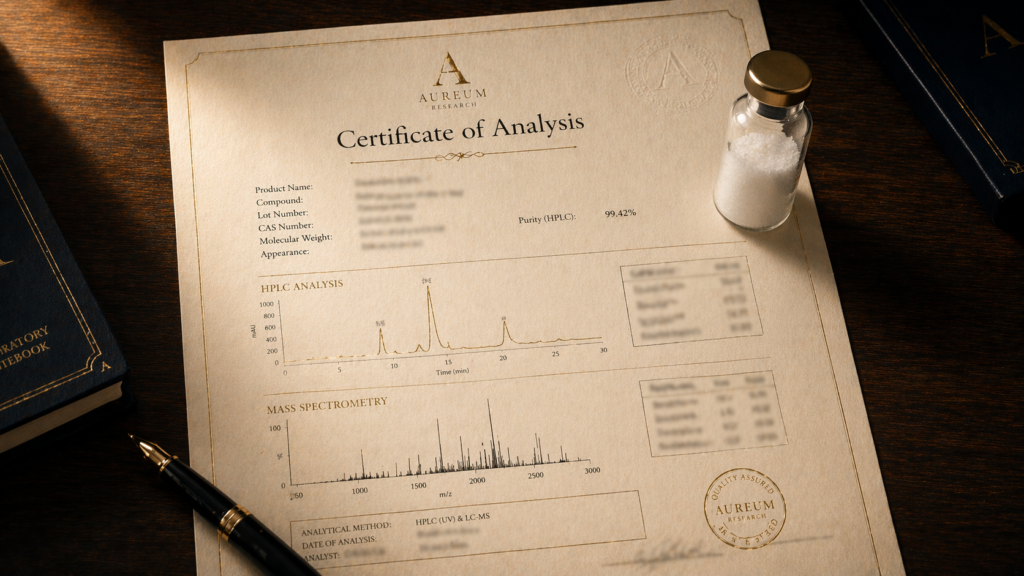
A comprehensive COA for synthetic peptides typically includes several categories of information. The header section contains the product name, catalog number, lot or batch number, sequence (in single-letter or three-letter amino acid code), molecular formula, and theoretical molecular weight. This information allows the researcher to confirm that the correct compound was received and to track the specific lot through their experimental records.
Every product from Aureum Peptides is accompanied by a detailed COA documenting full analytical characterization data.
Mass Spectrometry Data
Mass spectrometry (MS) is the primary tool for confirming peptide identity. The COA reports the observed molecular weight alongside the calculated (theoretical) molecular weight. For identity confirmation, the observed mass should agree with the calculated mass within the instrument precision, typically plus or minus 0.1% for electrospray ionization (ESI-MS) and plus or minus 0.05% for matrix-assisted laser desorption/ionization time-of-flight (MALDI-TOF).
When reviewing MS data, researchers should verify that the observed mass matches the expected value for the target sequence. Common mass discrepancies can indicate specific modifications: an increase of +16 Da suggests methionine or tryptophan oxidation, +1 Da may indicate asparagine deamidation, and larger deviations could suggest deletion sequences or incomplete deprotection (Kinter & Sherman, 2000, Protein Sequencing and Identification Using Tandem Mass Spectrometry, Wiley-Interscience).
Some COAs include the raw mass spectrum image, showing the charge state envelope (for ESI) or the molecular ion peak (for MALDI). Multiple charge states in ESI data are normal and are used to calculate the deconvoluted molecular weight.
HPLC Purity Analysis
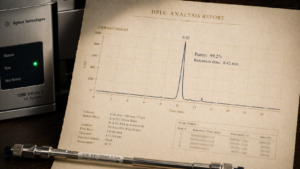
High-Performance Liquid Chromatography (HPLC) purity data is the quantitative backbone of the COA. The reported purity percentage represents the proportion of the target peptide relative to all detected species in the chromatographic separation.
Key elements to examine include the purity percentage itself (typically reported to one decimal place), the chromatographic method details (column type, mobile phase, gradient conditions, detection wavelength), and ideally the chromatogram image showing the separation. A well-resolved chromatogram with a dominant, symmetrical target peak and minimal satellite peaks provides confidence in the reported purity value.
Researchers should note that HPLC purity is method-dependent, meaning that different chromatographic conditions may yield slightly different values for the same sample. This is why reporting the analytical method is important for inter-laboratory comparisons (Snyder et al., 2010, Introduction to Modern Liquid Chromatography, 3rd Edition, Wiley).
Endotoxin Testing
For peptides intended for use in cell culture or other biological systems, endotoxin levels are a critical quality parameter. Endotoxins (lipopolysaccharides from gram-negative bacteria) can activate immune signaling pathways and introduce significant confounding variables in biological assays.
The Limulus Amebocyte Lysate (LAL) assay is the standard method for endotoxin quantification. Results are reported in Endotoxin Units per milligram (EU/mg). For research applications, levels below 1 EU/mg are generally considered acceptable, though more stringent limits may be appropriate for specific experimental designs.
The COA should specify the test method used (kinetic turbidimetric, chromogenic, or gel-clot) and the sensitivity limit of the assay. A result reported as “less than” the detection limit indicates that endotoxins were not detected above that threshold (Magalhaes et al., 2007, Journal of Pharmacy and Bioallied Sciences, 4(Suppl 2), S21-S25).
Amino Acid Analysis
Some COAs include amino acid analysis (AAA) data, which provides compositional verification independent of mass spectrometry. The peptide is hydrolyzed to its constituent amino acids, which are then quantified individually. The observed ratios are compared to the theoretical ratios based on the target sequence.
AAA is particularly valuable for confirming the identity of peptides with similar molecular weights but different sequences, and for detecting certain post-synthesis modifications that may not shift the mass significantly.
Appearance and Solubility
The COA typically describes the physical appearance of the product (e.g., white to off-white lyophilized powder) and may include solubility information. While these may seem like minor details, deviations from expected appearance can indicate manufacturing issues, degradation, or contamination. A peptide described as a white powder that arrives as a yellow or brown solid warrants inquiry with the supplier.
Counterion and Salt Form
Synthetic peptides are typically supplied as trifluoroacetate (TFA) or acetate salts, with the counterion acquired during HPLC purification. The COA should specify the salt form, as this affects the effective peptide content. For accurate concentration calculations, researchers must account for the counterion contribution to the total weight. A TFA salt peptide with a stated quantity of 10 mg may contain only 7-8 mg of the peptide itself, with the remainder being TFA counterions and associated water (Fields & Noble, 1990, International Journal of Peptide and Protein Research, 35(3), 161-214).
How to Use COA Data in Your Research
Researchers should file COAs with their laboratory records and reference them in experimental methods sections. When preparing stock solutions, use the net peptide content (accounting for counterion and moisture) rather than gross weight for accurate molar concentrations. Compare lot-to-lot COA data when repeating experiments to identify any variability that might explain differences in results.
For critical experiments, consider requesting COA data before purchase to verify that the product meets your specific analytical requirements. Reputable suppliers like Aureum Peptides make COA data available and maintain lot traceability throughout the product lifecycle.
Red Flags to Watch For
Be cautious of COAs that report purity without specifying the analytical method, provide rounded numbers without decimal precision, lack lot or batch numbers, omit the chromatogram or mass spectrum, or do not include the date of analysis. These omissions may indicate insufficient quality control processes and should prompt further inquiry with the supplier (Rathore & Winkle, 2009, Nature Biotechnology, 27(1), 26-34).
Conclusion
A Certificate of Analysis is not merely a formality; it is a critical research document that validates compound identity, purity, and suitability for use. Developing fluency in reading and evaluating COAs empowers researchers to make informed procurement decisions, troubleshoot unexpected experimental results, and maintain the analytical rigor that peer-reviewed science demands.
For research use only. Not for human consumption.