Overview
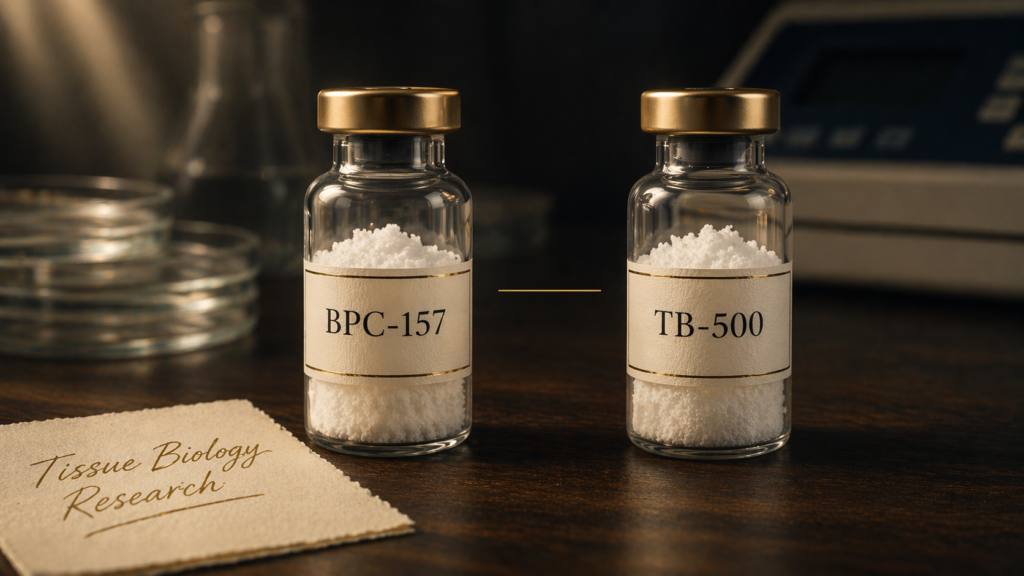
BPC-157 (Body Protection Compound-157) and TB-500 (Thymosin Beta-4 fragment) are among the most extensively studied compounds in tissue biology research. While both have been investigated in preclinical models examining tissue-related signaling pathways, they differ significantly in their molecular characteristics, mechanisms of action, and the scope of published research.
This comparison examines the key differences and similarities between these two research compounds based on published scientific literature. All information is for research reference only.
Molecular Comparison
| Property | BPC-157 | TB-500 |
|---|---|---|
| Peptide Type | Synthetic pentadecapeptide (15 amino acids) | Synthetic 43-amino acid peptide (fragment of Thymosin Beta-4) |
| Molecular Weight | 1419.53 g/mol | 4963.44 g/mol |
| CAS Number | 137525-51-0 | 77591-33-4 |
| Origin | Derived from human gastric juice protein | Fragment of naturally occurring Thymosin Beta-4 |
| Primary Research Focus | Cytoprotective pathways, gastric biology | Actin regulation, cell migration signaling |
| Storage | Lyophilized: -20C. Reconstituted: 2-8C | Lyophilized: -20C. Reconstituted: 2-8C |
Research Background: BPC-157
BPC-157 has been studied in over 100 published research papers, primarily examining its interactions with growth factor signaling pathways. Preclinical studies have investigated BPC-157 in models examining nitric oxide system modulation, angiogenesis-related gene expression, and gastrointestinal tissue biology (Sikiric et al., 2018, Current Pharmaceutical Design).
Research has focused on its stability profile in acidic environments, which distinguishes it from many other peptides that degrade rapidly under such conditions. This stability has been examined in the context of gastric juice protein research (Seiwerth et al., 2014, Journal of Physiology – Paris).
Research Background: TB-500
TB-500 (the active region of Thymosin Beta-4) has been investigated primarily for its role in actin sequestration and cell migration pathways. Published research has examined its involvement in cytoskeletal regulation and wound-related signaling cascades in various cell culture models (Goldstein et al., 2012, Expert Opinion on Biological Therapy).
Studies have also examined Thymosin Beta-4 in the context of cardiac tissue biology, with preclinical models investigating its effects on gene expression patterns related to tissue remodeling (Bock-Marquette et al., 2004, Nature).
Key Differences in Research Applications
While both compounds are studied in the context of tissue biology, their research applications differ:
- BPC-157 research has focused on gastrointestinal signaling, nitric oxide pathways, and growth factor interactions in preclinical models
- TB-500 research has centered on actin dynamics, cell motility, and cytoskeletal organization in cell culture studies
- BPC-157 is a smaller peptide (15 amino acids) compared to TB-500 (43 amino acids), which may influence research protocol design
- Published research volume is larger for BPC-157 in gastrointestinal biology, while TB-500 has more published data in cardiac biology models
Availability at Aureum Peptides
Both BPC-157 and TB-500 are available as research-grade compounds with 99%+ purity verification and Certificate of Analysis included. View our complete Tissue Biology Research collection.
References
- Sikiric P, et al. (2018). “Stable gastric pentadecapeptide BPC 157 in trials for inflammatory bowel disease.” Current Pharmaceutical Design, 24(18), 1991-2024.
- Seiwerth S, et al. (2014). “BPC 157 and standard angiogenic growth factors.” Journal of Physiology – Paris, 108(2-3), 146-155.
- Goldstein AL, et al. (2012). “Thymosin beta-4: a multi-functional regenerative peptide.” Expert Opinion on Biological Therapy, 12(1), 37-51.
- Bock-Marquette I, et al. (2004). “Thymosin beta-4 activates integrin-linked kinase.” Nature, 432(7016), 466-472.
Disclaimer: All products are intended strictly for in vitro research and laboratory use only. Not for human consumption. The information presented compares published scientific data and does not constitute medical or therapeutic advice.