Overview
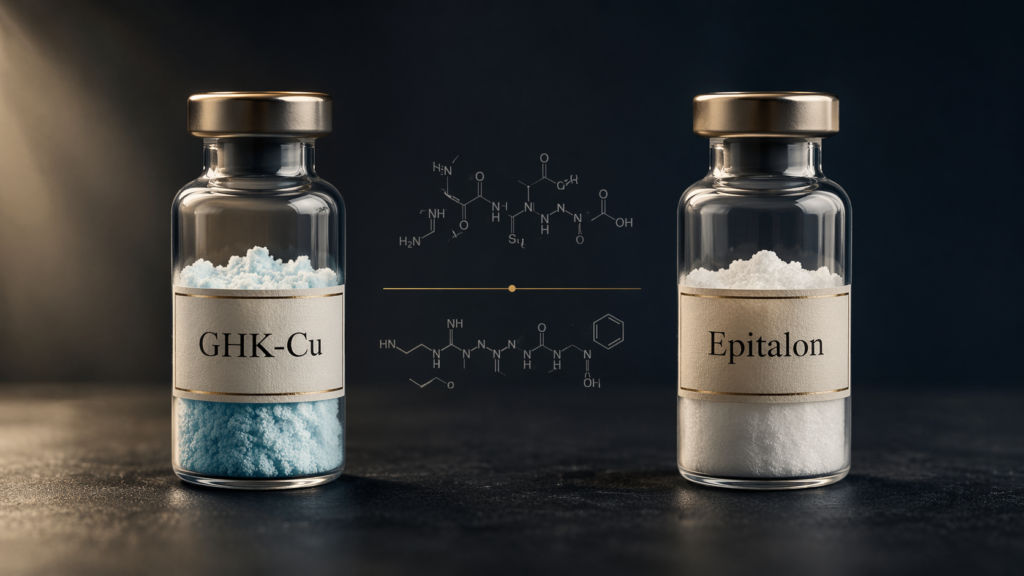
GHK-Cu (copper tripeptide-1) and Epitalon (epithalon/epithalone) represent two distinct approaches to cellular aging research. GHK-Cu is a naturally occurring copper-binding peptide studied for its role in extracellular matrix signaling, while Epitalon is a synthetic tetrapeptide investigated in the context of telomere biology and pineal gland signaling.
All information is for qualified researchers conducting in vitro studies.
Molecular Comparison
| Property | GHK-Cu | Epitalon |
|---|---|---|
| Full Name | Glycyl-L-Histidyl-L-Lysine Copper(II) | Ala-Glu-Asp-Gly (Epithalon) |
| Molecular Weight | 403.93 g/mol | 390.35 g/mol |
| CAS Number | 49557-75-7 | 307297-39-8 |
| Type | Metallopeptide (copper-binding tripeptide) | Synthetic tetrapeptide |
| Primary Research Focus | Extracellular matrix, copper signaling | Telomerase expression, pineal peptides |
Research Background: GHK-Cu
GHK-Cu was first identified by Pickart in 1973 as a copper-binding peptide found in human plasma. Subsequent research has examined its role in gene expression modulation, with studies identifying over 4,000 genes whose expression is influenced by GHK-Cu in cell culture models (Pickart et al., 2015, BioMed Research International).
Research has particularly examined GHK-Cu in the context of extracellular matrix biology, including studies on collagen-related gene expression, decorin signaling, and metalloproteinase regulation in fibroblast cultures (Pollard et al., 2005, Journal of Biological Chemistry).
Research Background: Epitalon
Epitalon is a synthetic analog of the naturally occurring pineal peptide epithalamin. It has been investigated in the context of telomerase reverse transcriptase (hTERT) gene expression in cell culture models (Khavinson et al., 2003, Bulletin of Experimental Biology and Medicine).
Published research has examined its effects on telomere length maintenance in human somatic cell cultures, with studies reporting measurable changes in telomerase activity following compound exposure in vitro (Anisimov et al., 2011, Cell Cycle).
Key Differences
- GHK-Cu is a metallopeptide requiring copper coordination for activity, studied in ECM remodeling contexts
- Epitalon is studied specifically in telomere biology and pineal gland peptide signaling
- GHK-Cu research spans dermatological, wound biology, and copper homeostasis fields
- Epitalon research is more narrowly focused on telomerase expression and circadian biology
Availability
Both GHK-Cu and Epitalon are available with 99%+ purity and COA. Browse our Cellular Aging Research collection.
References
- Pickart L, et al. (2015). “GHK peptide as a natural modulator of multiple cellular pathways.” BioMed Research International, 2015, 648108.
- Pollard JD, et al. (2005). “Synthetic GHK-Cu stimulates decorin expression.” Journal of Biological Chemistry, 280(16), 23766-23772.
- Khavinson VK, et al. (2003). “Tetrapeptide AEDG and telomerase activity.” Bulletin of Experimental Biology and Medicine, 135(6), 590-592.
- Anisimov VN, et al. (2011). “Epitalon and telomerase.” Cell Cycle, 10(21), 3731-3738.
Disclaimer: All products are intended strictly for in vitro research and laboratory use only. Not for human consumption.