
Bacteriostatic water
BW, Sterile Diluent with Preservative, Bacteriostatic Water for Injection USP
| Quantity | Discount | Price Each |
|---|---|---|
| 1 | — | $3.50 |
| 2+ | Save 5% | $3.32 |
| 3+ | Save 10% | $3.15 |
| 5+ | Save 15% | $2.98 |


Estimated delivery: Apr 21 – Apr 24
Standard delivery: Apr 22 – Apr 24 | Express: Apr 20 – Apr 21
Quality & Transparency
Every batch tested. Every result published. No exceptions.
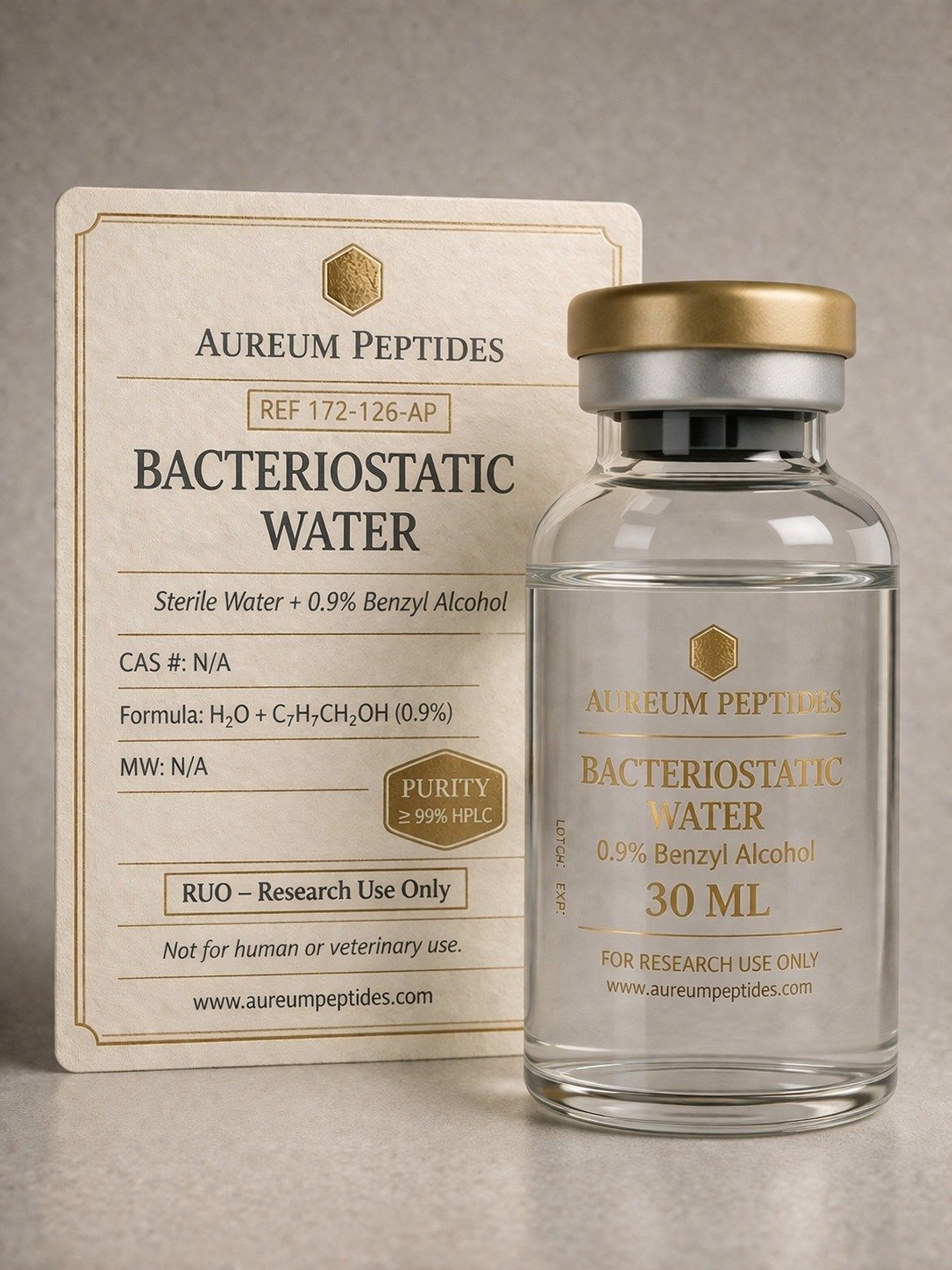
Bacteriostatic Water for Injection (USP) is sterile water containing 0.9% benzyl alcohol as a bacteriostatic preservative. It is used as a sterile diluent for reconstituting lyophilized research compounds. The benzyl alcohol preservative allows the vial to be punctured multiple times over a 28-day period while maintaining sterility.
Bacteriostatic water consists of Water for Injection (USP) with 0.9% (v/v) benzyl alcohol (C7H8O, MW 108.14 g/mol). The benzyl alcohol acts as a preservative by disrupting microbial cell membrane integrity.
pH range: 4.5-7.0
Osmolality: ~0 mOsm/kg (essentially water)
Endotoxin: <0.25 EU/mL (USP limit)
• Peptide reconstitution: Standard diluent for lyophilized peptide research compounds.
• Multi-use applications: Preservative allows repeated vial access for research studies.
• Stability studies: Used as a standard reconstitution vehicle in peptide stability research.
• Solubility testing: Used in peptide solubility characterization studies.
While bacteriostatic water itself does not directly modulate cellular signaling pathways, its role as a vehicle significantly influences experimental outcomes through effects on peptide stability, solubility, and bioavailability in research models. The benzyl alcohol preservative component has been examined in preclinical studies for potential interactions with biological systems. Research indicates benzyl alcohol undergoes rapid oxidation to benzoic acid via alcohol dehydrogenase enzymes in hepatic tissue, subsequently conjugating with glycine to form hippuric acid for renal elimination. At concentrations used in bacteriostatic water formulations, benzyl alcohol demonstrates minimal interference with common cellular signaling cascades in standard experimental protocols.
Investigation of vehicle effects in pharmacological research has revealed that reconstitution medium composition can influence peptide aggregation states, conformational stability, and receptor interaction kinetics. Studies comparing bacteriostatic water to alternative reconstitution vehicles have documented differences in peptide solubility profiles, particularly for hydrophobic sequences prone to aggregation. The preservative-containing formulation has shown utility in maintaining peptide integrity during storage intervals between experimental timepoints, reducing variability attributed to degradation or microbial contamination in multi-use vial scenarios.
In the context of in vivo research models, vehicle selection impacts subcutaneous depot formation, tissue distribution kinetics, and local inflammatory responses at injection sites. Preclinical comparative studies have examined tissue responses to various injection vehicles, with benzyl alcohol-containing formulations demonstrating distinct pharmacokinetic profiles compared to preservative-free alternatives. These observations emphasize the importance of consistent vehicle use across experimental replicates and appropriate vehicle control groups in research designs investigating peptide pharmacology and mechanism of action studies.
Extensive preclinical research has characterized the antimicrobial efficacy and preservative properties of benzyl alcohol in aqueous formulations. Microbiological challenge studies have demonstrated that 0.9% benzyl alcohol effectively inhibits growth of Staphylococcus aureus, Pseudomonas aeruginosa, Escherichia coli, and Candida albicans in multi-dose vial systems over 28-day test periods. These antimicrobial properties derive from benzyl alcohol's ability to disrupt bacterial cell membrane integrity and interfere with essential metabolic processes. Time-kill kinetic studies indicate concentration-dependent bacteriostatic activity, with 0.9% concentrations providing optimal preservation without compromising compatibility with most peptide structures.
Preclinical toxicology studies in rodent models have established safety profiles for benzyl alcohol at concentrations used in bacteriostatic water formulations. Repeated-dose studies in rats and mice receiving subcutaneous injections of benzyl alcohol-preserved vehicles have characterized dose-response relationships for local tissue effects and systemic exposure markers. Histopathological examination of injection sites has documented mild, transient inflammatory responses that resolve without intervention in standard experimental protocols. Metabolic studies using radiolabeled benzyl alcohol have traced conversion pathways through hepatic oxidation and subsequent glycine conjugation, with hippuric acid as the primary urinary metabolite in rodent models.
Comparative pharmacokinetic studies have evaluated vehicle effects on peptide bioavailability and tissue distribution in laboratory animals. Research using model peptides reconstituted in bacteriostatic water versus alternative vehicles has identified formulation-dependent differences in absorption rates, peak plasma concentrations, and elimination half-lives following subcutaneous administration in rats. These findings underscore the importance of vehicle consistency in experimental designs and highlight the role of reconstitution medium as a critical variable in peptide pharmacology research. Additional studies examining peptide stability in bacteriostatic water have documented preservation of biological activity over storage intervals relevant to multi-day experimental protocols.
Form: Clear, colorless sterile solution, 10mL per vial
Preservative: 0.9% benzyl alcohol
Sterility: Sterile filtered (0.22 μm) and autoclave sterilized
Every lot tested for sterility, endotoxin, pH, benzyl alcohol concentration, and particulate matter per USP standards.
This content was prepared for informational purposes based on published reference standards.
- 1United States Pharmacopeia. "Bacteriostatic Water for Injection." USP-NF. PubMed
- 2PDA Technical Report No. 26. "Sterilizing Filtration of Liquids." PDA J Pharm Sci Technol. 2008. PubMed
Advancing Research, One Peptide at a Time
Premium quality. Rigorous testing. Trusted by researchers worldwide.
| Test | Target | Result |
|---|---|---|
| Sterility (USP <71>) | No growth | Pass ✓ |
| Endotoxin (LAL) | <0.25 EU/mL | <0.1 EU/mL ✓ |
| Benzyl Alcohol Content | 0.9% u00b1 0.1% | 0.9% ✓ |
| pH | 4.5-7.0 | 5.5 ✓ |
| Particulate Matter | Meets USP <788> | Pass ✓ |
Temperature
Store at controlled room temperature: 20-25°C (68-77°F)
Do not freeze
Protect from light
Shelf Life
Unopened: 24 months at room temperature
28 days after first puncture
Handling
Multi-use vial — discard 28 days after first puncture.
Swab stopper with alcohol before each use.
Do not use if solution is discolored or contains particles.
Store upright.
Frequently Asked Questions
Stay at the Forefront
Join our research community. Get early access to new peptides, exclusive member pricing, and curated literature reviews delivered to your inbox.
Welcome to the Circle ✦
Check your inbox for your 10% welcome discount

Frequently Studied Together

Bacteriostatic water
Price range: $3.50 through $8.00
This itemResearch Compound Comparison
Side-by-side analysis of chemical profiles, research applications, and specifications