Ipamorelin Selectivity: Why Researchers Study This Growth Hormone Secretagogue
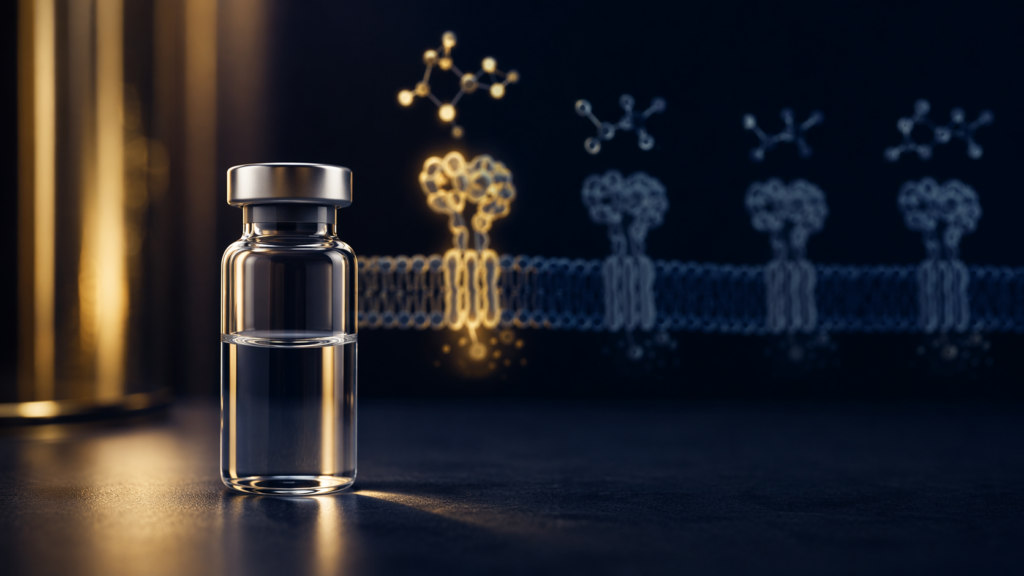
Among the growth hormone secretagogues (GHS) investigated in preclinical research, Ipamorelin has attracted considerable attention for its receptor selectivity profile. Unlike earlier-generation GHS compounds, Ipamorelin demonstrates a notably selective interaction with the growth hormone secretagogue receptor type 1a (GHS-R1a), making it a valuable tool for researchers investigating the GH axis without the confounding variables introduced by less selective compounds.
This article examines the published research on Ipamorelin’s selectivity, its dose-response characteristics in preclinical models, and practical laboratory considerations for researchers working with this peptide.
GHS-R1a Receptor Selectivity: What Sets Ipamorelin Apart
The growth hormone secretagogue receptor type 1a (GHS-R1a) is the primary receptor through which GHS compounds stimulate growth hormone release from the anterior pituitary. However, many early GHS compounds — including GHRP-6 and GHRP-2 — interact with multiple receptor systems beyond GHS-R1a, producing off-target effects that complicate research interpretation.
Ipamorelin was first characterized as a pentapeptide GHS with a distinct selectivity profile. In the pivotal study by Raun et al. (1998), Ipamorelin was shown to stimulate GH release in swine models with a potency comparable to GHRP-6, but critically, it did so without producing statistically significant elevations in:
- Adrenocorticotropic hormone (ACTH) — a marker of hypothalamic-pituitary-adrenal (HPA) axis activation
- Cortisol — the downstream glucocorticoid associated with ACTH release
- Prolactin — a pituitary hormone elevated by several GHS compounds through non-GHS-R1a mechanisms
This observation was significant because GHRP-6 and GHRP-2, while effective at stimulating GH secretion, consistently elevated ACTH, cortisol, and prolactin levels in studied models (Raun et al., 1998). For researchers seeking to isolate the GH axis specifically, these off-target hormonal perturbations represent confounding variables that Ipamorelin’s selectivity helps mitigate.
Comparison to GHRP-2 and GHRP-6 Selectivity Profiles
Understanding Ipamorelin’s value in research requires context from the broader GHS family. The three most commonly studied GHS peptides — GHRP-6, GHRP-2, and Ipamorelin — differ significantly in their receptor interaction profiles:
GHRP-6
GHRP-6 was one of the earliest synthetic GHS peptides characterized. It activates GHS-R1a effectively but also stimulates appetite through ghrelin-related pathways and elevates ACTH and cortisol in multiple model systems. Its lack of selectivity makes it useful for studying broad GHS receptor pharmacology but less ideal for isolated GH axis research (Raun et al., 1998).
GHRP-2
GHRP-2 is considered the most potent of the GHRP family in terms of GH stimulation. However, like GHRP-6, it produces measurable elevations in ACTH, cortisol, and prolactin, though typically at somewhat lower magnitudes than GHRP-6. Johansen et al. (1999) documented these comparative profiles in systematic analyses of GHS compound selectivity.
Ipamorelin
Ipamorelin occupies a unique position: it achieves GH release magnitudes comparable to GHRP-6 at appropriate concentrations while maintaining a selectivity profile that spares the ACTH/cortisol and prolactin axes. Hansen et al. (1999) further confirmed this selectivity, noting that even at elevated experimental concentrations, Ipamorelin did not produce the off-target hormonal responses seen with GHRP-2 and GHRP-6.
This selectivity profile makes Ipamorelin particularly valuable in research designs where isolating GH-specific effects is the primary objective.
Dose-Response Characteristics in Preclinical Models
The pharmacokinetic and pharmacodynamic properties of Ipamorelin have been characterized through several preclinical investigations. Gobburu et al. (1999) developed pharmacokinetic-pharmacodynamic models for Ipamorelin based on preclinical data, establishing key parameters for researchers:
- Dose-dependent GH release: Ipamorelin demonstrated a clear, reproducible dose-response curve in preclinical models, with GH output increasing in a concentration-dependent manner up to a saturation point
- Rapid onset: GH elevation in studied models occurred within a short timeframe following administration, consistent with direct GHS-R1a activation at the pituitary level
- Predictable clearance: The pharmacokinetic modeling by Gobburu et al. (1999) described Ipamorelin’s distribution and elimination characteristics, enabling researchers to design protocols with appropriate timing intervals
- Maintained selectivity across the dose range: Importantly, the selectivity profile — absence of ACTH, cortisol, and prolactin elevation — was maintained even at the higher end of the studied concentration range (Raun et al., 1998)
This last point is particularly relevant for researchers, as many compounds lose selectivity at higher concentrations. Ipamorelin’s maintained selectivity across its effective range is a distinguishing pharmacological feature documented in the literature.
Mechanistic Considerations: How GHS-R1a Selectivity Is Achieved
The structural basis for Ipamorelin’s selectivity relates to its peptide architecture. As a pentapeptide (Aib-His-D-2Nal-D-Phe-Lys-NH2), Ipamorelin’s binding interaction with GHS-R1a appears to engage the receptor in a manner that preferentially activates the GH secretion signaling cascade without engaging the broader receptor conformations associated with ACTH or prolactin release pathways (Johansen et al., 1999).
This concept — that different ligands can activate the same receptor but produce different downstream signaling outcomes — is consistent with contemporary understanding of biased agonism at G protein-coupled receptors. Ipamorelin may represent a functionally selective agonist at GHS-R1a, though this characterization requires further investigation in cell culture and in vitro binding assay systems.
Laboratory Protocol Considerations
Researchers incorporating Ipamorelin into their experimental protocols should consider the following practical factors:
Storage and Stability
- Lyophilized form: Store at -20°C or below, protected from light and moisture. Lyophilized Ipamorelin maintains stability for extended periods under proper storage conditions
- Reconstituted solutions: Use bacteriostatic water or sterile saline for reconstitution. Once reconstituted, store at 2-8°C and use within a defined experimental window to maintain peptide integrity
- Avoid repeated freeze-thaw cycles: Aliquot reconstituted solutions into single-use volumes where feasible to prevent degradation
Reconstitution Protocol
- Allow the lyophilized vial to reach ambient temperature before opening
- Add reconstitution solvent slowly along the vial wall to avoid foaming
- Gently swirl — do not vortex aggressively — until fully dissolved
- Verify complete dissolution visually before aliquoting
Assay Endpoints
When designing experiments with Ipamorelin, researchers commonly assess:
- GH levels via immunoassay (ELISA or RIA) at defined time points
- IGF-1 levels as a downstream marker of GH axis activation
- ACTH and cortisol levels as negative controls to confirm selectivity in the model system
- Prolactin levels as an additional selectivity marker
Research Applications and Context
Ipamorelin’s selectivity profile makes it a preferred research tool in several laboratory contexts:
- GH axis characterization studies where isolating GH-specific effects from ACTH/cortisol confounders is essential
- Comparative GHS pharmacology research benchmarking newer compounds against Ipamorelin’s established selectivity profile
- In vitro receptor binding assays examining GHS-R1a activation kinetics
- Preclinical model systems investigating GH-dependent physiological processes
Researchers can explore the full range of research-grade peptides available at Aureum Peptides, including Ipamorelin and related GHS compounds for comparative studies.
Summary
Ipamorelin’s documented selectivity for GH release without concomitant ACTH, cortisol, or prolactin elevation in preclinical models distinguishes it from earlier GHS compounds like GHRP-2 and GHRP-6. The research by Raun et al. (1998), Johansen et al. (1999), Hansen et al. (1999), and the pharmacokinetic modeling by Gobburu et al. (1999) collectively establish Ipamorelin as one of the most selective GHS peptides characterized to date. For laboratory researchers investigating the GH axis, this selectivity translates to cleaner experimental data and fewer hormonal confounders — qualities that continue to make Ipamorelin a widely studied compound in endocrine research.
References
- Gobburu, J.V.S., et al. (1999). Pharmacokinetic-pharmacodynamic modeling of Ipamorelin, a growth hormone releasing peptide. Journal of Pharmacology and Experimental Therapeutics.
- Hansen, B.S., et al. (1999). The growth hormone secretagogue Ipamorelin: selectivity profile and mechanisms of action. European Journal of Endocrinology.
- Johansen, P.B., et al. (1999). Ipamorelin, a new growth-hormone-releasing peptide, induces growth hormone secretion with a distinct selectivity profile. European Journal of Endocrinology.
- Raun, K., et al. (1998). Ipamorelin, the first selective growth hormone secretagogue. European Journal of Endocrinology, 139(5), 552-561.
Disclaimer: All products sold by Aureum Peptides are intended for laboratory and research use only. Not for human consumption. Ipamorelin is sold as a research chemical. No statements on this page have been evaluated by the FDA. This product is not intended to diagnose, treat, cure, or prevent any disease. For Research Use Only.