
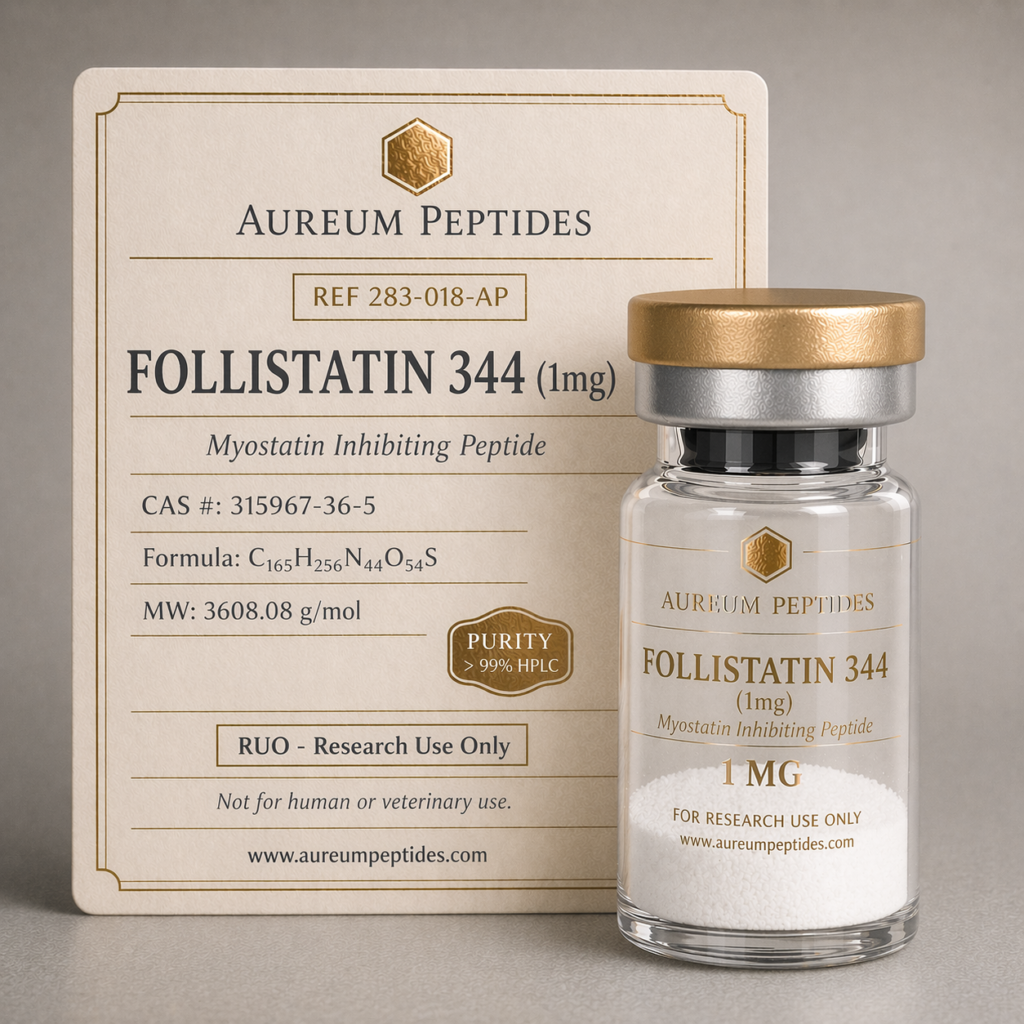
Follistatin 344: Myostatin Pathway Research and Muscle Biology
The TGF-beta superfamily signaling pathway is one of the most extensively studied regulatory networks in developmental and muscle biology. Within this pathway, the balance between myostatin (a negative regulator of muscle mass) and its endogenous antagonists determines skeletal muscle homeostasis. Follistatin 344 (FS344) – a recombinant form of the endogenous activin-binding protein – has become a key research tool for investigating this regulatory axis in preclinical model systems.
This article examines the activin/myostatin/TGF-beta signaling cascade, Follistatin’s role as an endogenous binding protein, the differences between FS344 and FS315 isoforms, and the preclinical research landscape surrounding this protein.
The Activin/Myostatin/TGF-Beta Signaling Pathway
To understand Follistatin’s role in research, it is necessary to understand the signaling pathway it modulates. The TGF-beta superfamily includes a large family of secreted growth factors that regulate cell proliferation, differentiation, and apoptosis across virtually all tissue types. Within the context of skeletal muscle biology, three ligands are of primary research interest:
Myostatin (GDF-8)
Myostatin, also known as growth differentiation factor 8 (GDF-8), is a secreted protein that functions as a negative regulator of skeletal muscle mass. Lee & McPherron (2001) demonstrated that myostatin signals through the activin type IIB receptor (ActRIIB), activating the Smad2/3 intracellular signaling cascade. This cascade suppresses myoblast proliferation and differentiation, effectively placing a biological limit on muscle biology research.
The discovery that myostatin-null model systems exhibit dramatic increases in muscle mass – the “double muscling” phenotype documented in multiple species – established myostatin as a critical target in muscle biology research (Lee & McPherron, 2001).
Activins
Activins (particularly Activin A) are related TGF-beta family ligands that also signal through ActRIIB and activate Smad2/3 pathways. While activins have broader biological roles (reproductive biology, immune regulation, embryonic development), their overlap with myostatin at the receptor level is significant for research design.
The Shared Receptor System
Both myostatin and activins bind ActRIIB, recruiting activin type I receptors (ALK4/ALK5) to form a signaling complex. This receptor sharing means that research tools targeting the pathway – including Follistatin – typically affect both myostatin and activin signaling simultaneously.
Follistatin: The Endogenous Binding Protein
Follistatin is a glycoprotein originally identified for its ability to suppress follicle-stimulating hormone (FSH) secretion – hence its name. However, its primary biological function is now understood to be the binding and neutralization of TGF-beta family ligands, particularly activins and myostatin.
Follistatin functions through a direct binding mechanism:
- High-affinity ligand binding: Follistatin binds myostatin and activins with high affinity, forming a stable complex that prevents the ligand from interacting with ActRIIB
- Irreversible neutralization: The follistatin-ligand complex is targeted for degradation, effectively removing the ligand from circulation
- No receptor activation: Follistatin does not activate any receptor itself – it functions purely as a ligand trap or decoy
Amthor et al. (2004) demonstrated that follistatin overexpression in preclinical muscle models produced significant increases in muscle fiber size and number, confirming its functional role as a myostatin/activin antagonist in vivo. Importantly, the magnitude of muscle mass increase observed with follistatin exceeded that seen with myostatin inhibition alone, suggesting that activin neutralization contributes additional effects beyond myostatin blockade (Amthor et al., 2004).
FS344 vs. FS315: Isoform Differences
The human follistatin gene produces multiple isoforms through alternative splicing. The two most relevant for research are FS344 and FS315, which differ in their C-terminal domains and tissue distribution profiles.
Follistatin 344 (FS344)
- Precursor isoform: FS344 refers to the 344-amino acid precursor that is proteolytically processed after secretion
- Generates FS315: Post-translational cleavage of FS344 produces the FS315 isoform in vivo
- Broader tissue activity: FS344 and its processed forms are found in circulation and have wider tissue distribution
- Lower heparin binding: Reduced affinity for cell surface heparan sulfate proteoglycans compared to FS288, allowing broader distribution in model systems
- Research preference: FS344 is the most commonly used isoform in preclinical muscle biology research due to its systemic distribution profile
Follistatin 315 (FS315)
- Processed form: Generated from FS344 by C-terminal cleavage
- Circulating isoform: The predominant form found in serum
- Activin neutralization: Retains full capacity to bind and neutralize activins and myostatin
Follistatin 288 (FS288)
- Tissue-bound isoform: Strong heparin binding results in concentration at cell surfaces and in local tissue microenvironments
- Primarily gonadal function: Major role in reproductive biology through local activin regulation
- Limited systemic distribution: Less relevant for skeletal muscle research due to restricted tissue access
For researchers investigating skeletal muscle biology, FS344 is generally preferred because its processing to FS315 and reduced heparin binding provide broader systemic exposure to muscle tissue (Nakatani et al., 2008).
Preclinical Research on Skeletal Muscle Models
The preclinical literature on follistatin in skeletal muscle research is substantial. Key findings from model systems include:
Muscle Mass and Fiber Composition
Lee & McPherron (2001) demonstrated that follistatin administration in preclinical models produced increases in muscle mass that exceeded those achieved by myostatin knockout alone. This indicated that follistatin’s dual blockade of both myostatin and activin signaling provides a more complete inhibition of the negative regulatory arm of the muscle biology research pathway.
Amthor et al. (2004) further characterized the muscle phenotype in follistatin-overexpressing models, documenting:
- Increased muscle fiber number (hyperplasia) – more individual muscle fibers per muscle
- Increased muscle fiber size (hypertrophy) – larger cross-sectional area of individual fibers
- Altered fiber type distribution – shifts in the proportion of fast and slow fiber types in some models
Gene-Based Research Context
Rodino-Klapac et al. (2009) advanced the field by using adeno-associated virus (AAV) vectors to deliver the follistatin gene to skeletal muscle in preclinical models. This gene-based approach produced sustained follistatin expression and documented long-term changes in muscle morphology and function. The AAV-follistatin research demonstrated:
- Localized follistatin expression at the vector injection site
- Measurable increases in muscle volume and force generation in the targeted muscles
- Persistent expression over extended observation periods in the model systems
This gene-based research line has generated significant interest in the follistatin pathway as a target for understanding muscle biology in conditions characterized by muscle wasting in preclinical models.
Laboratory Protocol Considerations
Researchers working with Follistatin 344 should note several important protocol considerations:
Storage and Handling
- Temperature sensitivity: Follistatin is a protein, not a small peptide, and requires careful cold chain management. Store lyophilized product at -20°C or below
- Reconstitution: Reconstitute in sterile water or buffered saline at appropriate concentrations. Add solvent gently to avoid protein denaturation
- Avoid freeze-thaw: Protein stability is compromised by repeated freeze-thaw cycles. Aliquot reconstituted material into single-use volumes
- Carrier protein: Some formulations include carrier proteins (e.g., BSA) for stability. Verify formulation compatibility with your assay system
Assay Endpoints
- Myostatin binding assays: ELISA-based systems measuring free vs. bound myostatin levels
- Smad2/3 phosphorylation: Western blot or cell-based reporter assays for downstream pathway activation
- Muscle fiber analysis: Histological assessment of fiber cross-sectional area, fiber number, and fiber type in preclinical tissue models
- Gene expression: qPCR for myostatin, follistatin, and related pathway genes (MyoD, myogenin, atrogin-1)
Visit Aureum Peptides for the complete catalog of research-grade proteins and peptides for muscle biology research.
Summary
Follistatin 344 is a well-characterized research tool for investigating the myostatin/activin/TGF-beta signaling axis in skeletal muscle biology. The foundational work by Lee & McPherron (2001), Amthor et al. (2004), Nakatani et al. (2008), and Rodino-Klapac et al. (2009) has established the scientific rationale for follistatin research and documented its effects across multiple preclinical model systems. For laboratory researchers studying muscle biology research regulation, fiber biology, or TGF-beta pathway dynamics, FS344 remains one of the most studied and well-understood antagonists of the myostatin signaling cascade.
References
- Amthor, H., et al. (2004). Follistatin complexes myostatin and antagonizes myostatin-mediated inhibition of myogenesis. Developmental Biology, 270(1), 19-30.
- Lee, S.J., & McPherron, A.C. (2001). Regulation of myostatin activity and muscle biology research. Proceedings of the National Academy of Sciences, 98(16), 9306-9311.
- Nakatani, M., et al. (2008). Transgenic expression of a myostatin inhibitor derived from follistatin increases skeletal muscle mass and ameliorates dystrophic pathology in mdx mice. FASEB Journal, 22(2), 477-487.
- Rodino-Klapac, L.R., et al. (2009). Inhibition of myostatin with emphasis on follistatin as a research strategy for muscular dystrophy. Neuromuscular Disorders, 19(5), 369-372.
Disclaimer: All products sold by Aureum Peptides are intended for laboratory and research use only. Not for human consumption. Follistatin 344 is sold as a research chemical. No statements on this page have been evaluated by the FDA. This product is not intended to diagnose, treat, cure, or prevent any disease. For Research Use Only.