Selank
TP-7, Thr-Lys-Pro-Arg-Pro-Gly-Pro, Tuftsin analog, Selanc, TKPRPGP
Quality & Transparency
Every batch tested. Every result published. No exceptions.
Selank is a synthetic heptapeptide derived from the naturally occurring immunomodulatory peptide tuftsin. Classified as a nootropic peptide analog, Selank was developed through structural modification to enhance metabolic stability and extend biological half-life relative to its parent compound. The peptide consists of the tuftsin sequence (Thr-Lys-Pro-Arg) with a C-terminal extension of Pro-Gly-Pro. Research interest in Selank centers on its potential interactions with neurotransmitter systems, particularly GABAergic and monoaminergic pathways, as well as its effects on gene expression related to neuroplasticity and immune function in preclinical models. Laboratory investigations have explored its role in modulating anxiety-like behaviors, cognitive performance, and stress response mechanisms in rodent studies.
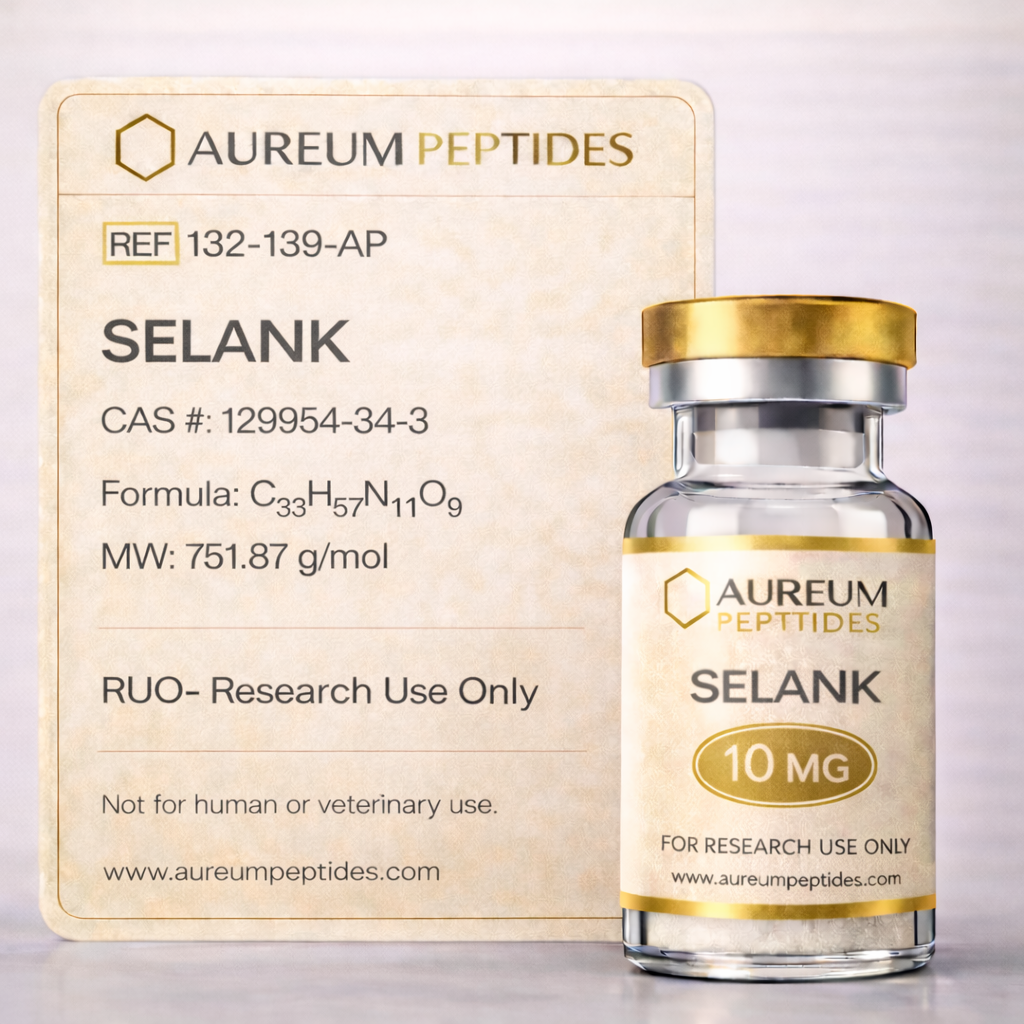
Selank possesses the amino acid sequence Thr-Lys-Pro-Arg-Pro-Gly-Pro (TKPRPGP), corresponding to molecular formula C33H57N11O9 with a molecular weight of 751.9 Da. The peptide architecture features the active tuftsin core (residues 1-4) responsible for immunomodulatory properties, followed by a proline-rich C-terminal extension that confers enhanced proteolytic resistance. Structural studies indicate that the Pro-Gly-Pro tail reduces susceptibility to carboxypeptidase degradation, extending the compound's stability in biological matrices compared to native tuftsin. In receptor binding assays, Selank has demonstrated interactions with components of the GABAergic system and influences on monoamine metabolism, though direct high-affinity receptor targets remain subjects of ongoing investigation. The peptide exhibits favorable aqueous solubility and maintains structural integrity under physiological pH conditions in vitro.
Selank serves as a molecular probe in neuroscience research investigating anxiety-related pathways, cognitive function modulators, and stress response systems in preclinical models. Its structural relationship to tuftsin and enhanced stability profile make it valuable for examining peptidergic signaling mechanisms and neuroimmune interactions in controlled laboratory settings.
- Behavioral neuroscience studies examining anxiety-like phenotypes in rodent models including elevated plus maze and open field paradigms
- Gene expression profiling of brain-derived neurotrophic factor (BDNF) and related neuroplasticity markers in hippocampal and cortical tissue preparations
- GABAergic receptor binding assays and functional coupling studies in neuronal cell lines
- Monoamine neurotransmitter quantification (serotonin, dopamine, norepinephrine) in brain tissue homogenates following peptide exposure
- Immunomodulation research using cytokine expression panels and lymphocyte proliferation assays
- Stress-induced molecular marker investigations including corticosterone measurement and hypothalamic-pituitary-adrenal axis activation studies
- Cognitive performance assessments in memory consolidation paradigms such as Morris water maze and novel object recognition tasks
Laboratory investigations indicate that Selank influences multiple molecular pathways relevant to neuronal signaling and immune regulation. In vitro studies have demonstrated effects on GABAergic neurotransmission, with research suggesting modulation of GABA-A receptor subunit expression in neuronal cultures. This interaction may contribute to observed alterations in inhibitory neurotransmission patterns documented in electrophysiological recordings. Additionally, preclinical data indicate that Selank exposure correlates with changes in monoamine metabolism, including modifications to serotonin and dopamine turnover ratios in discrete brain regions such as the hippocampus and prefrontal cortex.
Gene expression analyses have revealed that Selank administration in animal models associates with upregulation of neurotrophic factors, particularly brain-derived neurotrophic factor (BDNF) and its receptor TrkB in hippocampal tissues. These molecular changes occur alongside alterations in synaptic plasticity markers including synaptophysin and PSD-95. Research has also identified modulation of enkephalin metabolism and expression patterns, suggesting interactions with endogenous opioid systems. At the neuroimmune interface, in vitro experiments demonstrate effects on interleukin expression profiles and lymphocyte activation markers, consistent with Selank's derivation from the immunomodulatory peptide tuftsin. These pathway-level observations position Selank as a tool for investigating the molecular integration of stress response, cognitive processing, and immune signaling in experimental neuroscience contexts.
Preclinical research in rodent models has documented numerous molecular and behavioral correlates following Selank administration. Studies utilizing elevated plus maze and open field tests report decreased anxiety-like behaviors in mice and rats, accompanied by reduced plasma corticosterone levels and altered c-Fos expression patterns in amygdala and hippocampal structures. Gene expression profiling in these models reveals increased BDNF mRNA and protein levels in cortical and hippocampal tissues, suggesting engagement of neuroplasticity mechanisms. Quantitative neurochemistry studies have measured changes in monoamine content, with several investigations reporting increased serotonin turnover and modified dopamine metabolite ratios in prefrontal cortex and striatum following peptide exposure.
Cognitive performance paradigms including Morris water maze and passive avoidance tasks have shown enhanced memory consolidation parameters in rodents receiving Selank, correlating with molecular markers of synaptic strengthening. In vitro cell culture experiments using primary neuronal preparations and immortalized cell lines demonstrate neuroprotective effects against oxidative stress and excitotoxic insults, with associated reductions in caspase activation and improvements in mitochondrial membrane potential. Immunological studies in laboratory animals have documented alterations in cytokine profiles, T-cell proliferation rates, and antibody production following antigenic challenge. These findings collectively position Selank as a research tool for investigating the molecular underpinnings of anxiety-related behaviors, cognitive enhancement mechanisms, and neuroimmune integration in controlled experimental settings.
Selank is supplied as a sterile, lyophilized powder optimized for reconstitution in laboratory research applications. Each production batch undergoes comprehensive analytical verification including high-performance liquid chromatography (HPLC) to confirm ≥98% purity and reverse-phase chromatographic profiling to assess degradation products. Molecular identity is verified through matrix-assisted laser desorption/ionization mass spectrometry (MALDI-MS) and electrospray ionization mass spectrometry (ESI-MS), confirming the expected mass-to-charge ratio corresponding to the heptapeptide sequence. Endotoxin content is quantified via Limulus Amebocyte Lysate (LAL) assay to ensure levels remain below specified thresholds suitable for cell culture work. Certificates of Analysis (COA) are provided with each shipment, documenting these analytical parameters to support reproducibility and consistency in experimental workflows.
- 1Uchakina ON et al., Immunopharmacol Immunotoxicol, 2008 30(4):841-851. PubMed
- 2Ashmarin IP et al., Neurosci Behav Physiol, 1997 27(4):387-397. PubMed
- 3Inozemtsev AN et al., Bull Exp Biol Med, 2009 148(1):73-75. PubMed
- 4Kozlovskaya MM et al., Neurosci Behav Physiol, 2003 33(7):641-648. PubMed
- 5Kolomin T et al., J Psychopharmacol, 2013 27(8):721-729. PubMed
- 6Shevchenko KG et al., Bull Exp Biol Med, 2012 153(4):455-458. PubMed
- 7Filaretova LP et al., Neurosci Behav Physiol, 2007 37(3):245-251. PubMed
- 8Zozulya AA et al., J Neuroimmunol, 2008 206(1-2):39-46. PubMed
- 9Alferov NN et al., Neurochem J, 2010 4(2):114-118. PubMed
- 10Medvedeva EV et al., Bull Exp Biol Med, 2013 154(5):601-604. PubMed
- 11Solov'eva OA et al., Bull Exp Biol Med, 2016 161(3):377-379. PubMed
Advancing Research, One Peptide at a Time
Premium quality. Rigorous testing. Trusted by researchers worldwide.

Third-party testing data will be displayed here once available.
Temperature
Lyophilized: -20°C
Reconstituted: 2-8°C (30 days)
Shelf Life
24 months lyophilized
30 days reconstituted
Handling
Avoid freeze-thaw cycles.
Use bacteriostatic water for reconstitution.
Frequently Asked Questions
Stay at the Forefront
Join our research community. Get early access to new peptides, exclusive member pricing, and curated literature reviews delivered to your inbox.
Welcome to the Circle ✦
Check your inbox for your 10% welcome discount
Related Peptides
Explore complementary research compounds