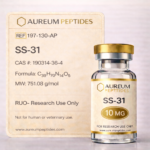
SS-31
Elamipretide, MTP-131, Bendavia, D-Arg-Dmt-Lys-Phe-NH2, Mitochondria-targeting peptide 131, Szeto-Schiller peptide 31

Quality & Transparency
Every batch tested. Every result published. No exceptions.
SS-31, also known as Elamipretide or MTP-131, is a synthetic tetrapeptide classified as a mitochondria-targeting aromatic-cationic peptide. Its structure comprises D-Arg-2',6'-dimethyltyrosine-Lys-Phe-NH2, designed to selectively localize to the inner mitochondrial membrane. SS-31 has emerged as a focal point in preclinical research investigating mitochondrial bioenergetics, oxidative stress modulation, and cardiolipin interactions. Laboratory investigations primarily examine its potential to modulate mitochondrial function in cell culture systems and animal models of mitochondrial dysfunction, ischemia-reperfusion injury, neurodegenerative processes, and metabolic disorders. The compound's unique membrane-targeting properties and small molecular architecture make it a valuable tool for dissecting mitochondrial biology in experimental settings.
SS-31 is a tetrapeptide with the sequence D-Arg-2',6'-dimethyltyrosine-Lys-Phe-NH2, possessing a molecular weight of approximately 640 Da. Its structural design incorporates alternating aromatic and cationic residues that facilitate selective accumulation at the inner mitochondrial membrane independent of membrane potential. The dimethyltyrosine residue provides hydrophobic character while the D-arginine and lysine confer positive charge, enabling electrostatic interactions with cardiolipin, a phospholipid enriched in mitochondrial membranes. In vitro stability studies indicate resistance to peptidase degradation due to the D-amino acid configuration. The peptide demonstrates aqueous solubility and maintains structural integrity across physiological pH ranges. Binding studies reveal preferential association with cardiolipin over other phospholipids, with dissociation constants in the micromolar range, supporting its classification as a cardiolipin-targeting agent in mitochondrial research.
SS-31 serves as a specialized research tool for investigating mitochondrial structure-function relationships in preclinical models. Its cardiolipin-binding properties enable experimental dissection of mitochondrial membrane dynamics, cristae organization, and bioenergetic efficiency. Laboratory applications span cellular bioenergetics, oxidative stress biology, and tissue-specific mitochondrial pathology models. Researchers employ SS-31 in controlled experimental paradigms to examine fundamental questions about mitochondrial quality control and cellular energetics.
- Mitochondrial respiration analysis using Seahorse extracellular flux assays and polarographic oxygen consumption measurements in isolated mitochondria and intact cells
- Cardiolipin peroxidation assays and lipidomic profiling to assess phospholipid stability under oxidative stress conditions
- Ischemia-reperfusion injury models in isolated heart preparations and in vivo coronary ligation studies
- Neuronal cell culture models examining mitochondrial morphology, cristae structure, and synaptic mitochondrial function
- Reactive oxygen species quantification using fluorescent probes and electron paramagnetic resonance spectroscopy
- ATP production kinetics and mitochondrial coupling efficiency measurements
- Electron transport chain complex activity assays and supercomplex assembly analysis
In laboratory research contexts, SS-31 interacts with cardiolipin, a dimeric phospholipid that constitutes approximately 20% of inner mitochondrial membrane lipid content. Cardiolipin plays critical structural roles in maintaining cristae architecture and facilitating optimal electron transport chain supercomplex assembly. In vitro studies indicate that SS-31 binding to cardiolipin may reduce cytochrome c peroxidase activity, potentially modulating the initiation of apoptotic cascades. Experimental evidence from isolated mitochondria suggests the peptide influences the organization of respiratory chain complexes, particularly Complex III and IV, which show cardiolipin-dependent activity.
Preclinical models have demonstrated that SS-31 application correlates with alterations in mitochondrial permeability transition pore dynamics, though the precise molecular mechanisms remain under investigation. Cell culture experiments using oxidative stress inducers show that SS-31 presence associates with reduced cytochrome c release and maintained cristae structure. Research using electron microscopy and tomographic reconstruction in cardiac myocytes reveals that SS-31 exposure corresponds with preserved mitochondrial ultrastructure under energetic stress conditions. Mechanistic studies employing genetic cardiolipin synthase knockdown models confirm that SS-31 effects depend on cardiolipin presence, establishing specificity of the peptide-lipid interaction in experimental systems.
Extensive preclinical investigations have characterized SS-31 effects across diverse experimental models. In rodent models of myocardial ischemia-reperfusion, SS-31 administration prior to coronary occlusion has been associated with reduced infarct size and preserved left ventricular function, correlating with maintained mitochondrial respiratory capacity and reduced oxidative damage markers. Isolated perfused heart studies demonstrate that SS-31 preserves ATP levels and reduces lactate accumulation during ischemic periods. Cell culture models using H9c2 cardiomyocytes and primary neonatal cardiomyocytes exposed to hypoxia-reoxygenation show that SS-31 application maintains mitochondrial membrane potential and reduces caspase activation.
Neuroscience research has employed SS-31 in cellular and animal models relevant to neurodegenerative processes. Primary cortical neuron cultures treated with amyloid-beta or oxidative stressors show preservation of synaptic mitochondrial function and dendritic spine density in the presence of SS-31. Transgenic mouse models expressing mutant proteins associated with mitochondrial dysfunction have shown improved motor performance and reduced neuronal loss when administered SS-31, alongside biochemical evidence of enhanced mitochondrial bioenergetics. Aging research has utilized the peptide in senescence-accelerated mouse strains, observing correlations between SS-31 exposure and maintained mitochondrial DNA integrity, reduced oxidative protein modifications, and preserved tissue ATP content across multiple organ systems including skeletal muscle, kidney, and brain.
SS-31 is supplied as a lyophilized powder optimized for stability during storage and reconstitution flexibility for diverse experimental protocols. Each lot undergoes rigorous analytical verification including high-performance liquid chromatography (HPLC) to confirm ≥95% purity, with detailed chromatographic profiles documenting peak integration. Mass spectrometry analysis, typically utilizing electrospray ionization (ESI) or MALDI-TOF platforms, verifies molecular weight and structural identity. Endotoxin levels are quantified using Limulus Amebocyte Lysate (LAL) assays to ensure compatibility with cell culture applications. A Certificate of Analysis (COA) accompanies each product, documenting batch-specific analytical results. These quality control measures support reproducibility and consistency in laboratory research workflows requiring defined peptide preparations.
- 1Szeto HH. Cell-permeable, mitochondrial-targeted, peptide antioxidants. AAPS J. 2006;8(2):E277-E283. PubMed
- 2Zhao K et al. Cell-permeable peptide antioxidants targeted to inner mitochondrial membrane inhibit mitochondrial swelling, oxidative cell death, and reperfusion injury. J Biol Chem. 2004;279(33):34682-34690. PubMed
- 3Birk AV et al. The mitochondrial-targeted compound SS-31 re-energizes ischemic mitochondria by interacting with cardiolipin. J Am Soc Nephrol. 2013;24(8):1250-1261. PubMed
- 4Szeto HH et al. Mitochondria-targeted peptide accelerates ATP recovery and reduces ischemic kidney injury. J Am Soc Nephrol. 2011;22(6):1041-1052. PubMed
- 5Dai DF et al. Mitochondrial targeted antioxidant peptide ameliorates hypertensive cardiomyopathy. J Am Coll Cardiol. 2011;58(1):73-82. PubMed
- 6Cho S et al. Mitochondrial targeting peptide protects against mutant huntingtin toxicity. Cell Death Differ. 2010;17(7):1137-1146. PubMed
- 7Kloner RA et al. Reduction of ischemia/reperfusion injury with bendavia, a mitochondria-targeting cytoprotective peptide. J Am Heart Assoc. 2012;1(3):e001644. PubMed
- 8Slone J et al. SS-31 peptide treatment and skeletal muscle mitochondrial function in aging. Physiol Rep. 2014;2(5):e00284. PubMed
- 9Arguello RJ et al. SS-31 treatment preserves cardiac and skeletal muscle mitochondrial function in type 2 diabetic db/db mice. Obesity (Silver Spring). 2014;22(7):1610-1617. PubMed
- 10Eirin A et al. Mitochondrial targeted peptides attenuate residual myocardial damage after ischemia-reperfusion injury. BMC Cardiovasc Disord. 2012;12:49. PubMed
- 11Sustarsic EG et al. Cardiolipin synthesis in brown and beige fat mitochondria is essential for systemic energy homeostasis. Cell Metab. 2018;28(1):159-174. PubMed
- 12Steenbergen C et al. Cardiolipin and electron transport chain optimality. Chem Phys Lipids. 2014;179:11-19. PubMed
Advancing Research, One Peptide at a Time
Premium quality. Rigorous testing. Trusted by researchers worldwide.
Third-party testing data will be displayed here once available.
Temperature
Lyophilized: -20°C
Reconstituted: 2-8°C (30 days)
Shelf Life
24 months lyophilized
30 days reconstituted
Handling
Avoid freeze-thaw cycles.
Use bacteriostatic water for reconstitution.
Frequently Asked Questions
Stay at the Forefront
Join our research community. Get early access to new peptides, exclusive member pricing, and curated literature reviews delivered to your inbox.
Welcome to the Circle ✦
Check your inbox for your 10% welcome discount
Related Peptides
Explore complementary research compounds