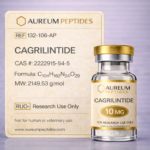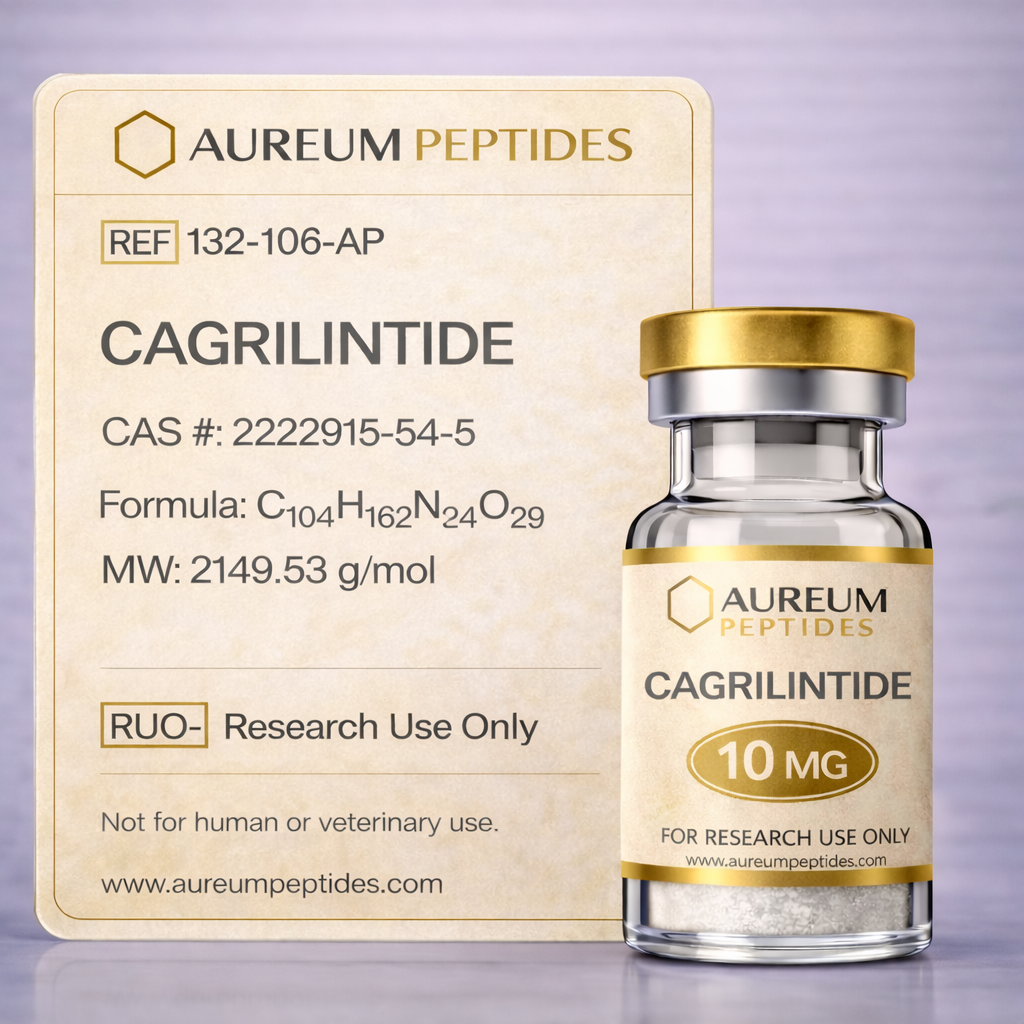
Cagrilintide
NN9056, Cagrilintide Acetate, Long-Acting Amylin Analog, Acylated Amylin Analog, Dual Amylin-Calcitonin Receptor Agonist

Quality & Transparency
Every batch tested. Every result published. No exceptions.
Cagrilintide is a long-acting synthetic peptide analog of amylin, a neuroendocrine hormone co-secreted with insulin from pancreatic beta cells. This research compound is classified as a dual amylin and calcitonin receptor agonist, designed with structural modifications that extend its pharmacokinetic profile compared to native amylin. With a molecular weight of 4409 Da and molecular formula C194H312N54O59S2, cagrilintide represents an advanced peptide construct incorporating acylation strategies to enhance albumin binding and prolong biological activity in experimental systems. In laboratory research, cagrilintide serves as a valuable tool for investigating amylin receptor signaling pathways, neuroendocrine regulation of metabolic processes, and the intersection of calcitonin and amylin receptor biology. Preclinical studies suggest its utility in models examining energy homeostasis, gastrointestinal physiology, and central nervous system-mediated metabolic control. Researchers utilize this peptide to explore receptor pharmacology, downstream signaling cascades, and tissue-specific responses to prolonged amylin receptor activation in controlled experimental settings.
Cagrilintide is structurally derived from human amylin (islet amyloid polypeptide, IAPP) with strategic amino acid substitutions and an acyl side chain modification that facilitates reversible albumin binding. The peptide incorporates proline substitutions at positions associated with aggregation propensity in native amylin, enhancing stability and solubility in aqueous research solutions. The acylation moiety, similar to technologies employed in other long-acting peptide therapeutics, extends the elimination half-life by promoting albumin association and reducing renal clearance in experimental models. Cagrilintide demonstrates high-affinity binding to both amylin receptors (AMY1, AMY2, AMY3 subtypes) and calcitonin receptors (CTR), functioning as a receptor agonist in cell-based assays. The compound exhibits stability in lyophilized form and demonstrates consistent reconstitution properties in laboratory buffers. In vitro binding studies indicate nanomolar affinity for receptor complexes formed by the calcitonin receptor and receptor activity-modifying proteins (RAMPs), which determine receptor subtype specificity. These biochemical properties make cagrilintide suitable for extended exposure studies in cellular and animal research models.
In preclinical research, cagrilintide serves as a molecular tool for investigating amylin and calcitonin receptor biology, neuroendocrine signaling mechanisms, and the physiological roles of prolonged receptor activation. Laboratory investigators employ this peptide analog in diverse experimental paradigms examining receptor pharmacology, intracellular signaling architecture, and organ-specific responses to sustained agonist exposure.
- Receptor binding and competition assays characterizing amylin receptor subtypes (AMY1-3) and calcitonin receptor interactions in transfected cell lines
- Cyclic AMP (cAMP) accumulation studies examining G-protein coupled receptor signaling kinetics and dose-response relationships
- Gene expression profiling in neuronal and peripheral tissues following receptor activation to map transcriptional responses
- Gastric emptying assessments in rodent models utilizing radiolabeled meal markers and imaging techniques
- Central nervous system penetration studies employing radiolabeled analogs and autoradiographic mapping of receptor distribution
- Energy balance investigations in metabolic chambers measuring oxygen consumption, carbon dioxide production, and activity patterns
- Co-administration studies with insulin or incretin mimetics examining synergistic or additive effects on metabolic parameters
Cagrilintide exerts its molecular effects through activation of amylin and calcitonin receptor complexes, which belong to the class B G-protein coupled receptor (GPCR) family. Amylin receptors are heteromeric complexes formed by the calcitonin receptor core protein (CTR) associated with receptor activity-modifying proteins (RAMP1, RAMP2, or RAMP3), generating AMY1, AMY2, and AMY3 receptor subtypes with distinct pharmacological profiles. Upon agonist binding, these receptors couple primarily to Gs proteins, activating adenylyl cyclase and elevating intracellular cAMP concentrations. In experimental neuronal systems, this cAMP elevation triggers protein kinase A (PKA) activation and downstream phosphorylation of cAMP response element-binding protein (CREB), modulating transcription of genes involved in neuronal excitability and neuropeptide expression.
In vitro studies indicate that cagrilintide-mediated receptor activation in hypothalamic neuronal cultures influences the expression of neuropeptides associated with satiety signaling, including modulation of proopiomelanocortin (POMC) and neuropeptide Y (NPY) pathways. The compound's interaction with area postrema neurons, a circumventricular organ lacking a complete blood-brain barrier, provides a mechanistic basis for central nervous system effects observed in research models. Additionally, peripheral amylin receptor activation in gastric tissues has been associated with altered contractility patterns and modified gastric smooth muscle signaling cascades involving calcium mobilization and myosin light chain phosphorylation in ex vivo tissue preparations.
Calcitonin receptor activation by cagrilintide in bone-derived cell lines triggers signaling cascades beyond cAMP generation, including activation of extracellular signal-regulated kinases (ERK1/2) and modulation of intracellular calcium dynamics. Research observations suggest that prolonged receptor occupancy, as achieved with long-acting analogs, may induce receptor desensitization patterns distinct from native ligands, with implications for experimental design in chronic exposure studies. These pathway-level insights inform experimental approaches investigating receptor biology, signaling network architecture, and the temporal dynamics of GPCR activation in laboratory models.
Preclinical investigations utilizing cagrilintide have expanded understanding of amylin receptor biology and its role in physiological regulation. In rodent research models, administration of cagrilintide has been associated with dose-dependent activation of neurons in the area postrema and nucleus tractus solitarius, brain regions densely populated with amylin receptors, as demonstrated through c-Fos immunohistochemistry studies. These neuronal activation patterns correlate with observed modifications in feeding behavior parameters, including reduced meal size and altered meal frequency in controlled laboratory settings. Telemetric gastric emptying studies in rat models utilizing non-absorbable markers have documented delayed gastric transit following cagrilintide administration, consistent with amylin's known physiological role in gastrointestinal motility regulation.
In vitro receptor pharmacology studies employing cells expressing recombinant amylin receptor subtypes have characterized cagrilintide's binding affinity and functional potency across AMY1, AMY2, and AMY3 receptors. These investigations reveal EC50 values in the low nanomolar range for cAMP accumulation across receptor subtypes, with prolonged receptor occupancy compared to native amylin due to the compound's albumin-binding properties. Metabolic cage studies in diet-induced obese mouse models have documented alterations in respiratory exchange ratio and reduced food intake over multi-week administration periods, providing data on sustained biological activity in experimental obesity research paradigms.
Pharmacokinetic characterization in multiple rodent species has demonstrated extended elimination half-lives compared to unmodified amylin analogs, with measurable plasma concentrations persisting beyond 72 hours in rat models following single-dose administration. These extended exposure profiles enable experimental designs investigating chronic receptor activation effects. Combination studies in diabetic rodent models co-administering cagrilintide with insulin analogs have revealed synergistic effects on glycemic parameters and body composition metrics, informing research into multi-hormone signaling integration. Receptor autoradiography studies using radiolabeled cagrilintide have mapped binding site distribution across brain regions and peripheral tissues, confirming expression patterns consistent with known amylin and calcitonin receptor localization.
Cagrilintide is supplied as a sterile, lyophilized powder optimized for stability during storage and reconstitution consistency in laboratory applications. Each batch undergoes comprehensive analytical verification using high-performance liquid chromatography (HPLC) to confirm purity ≥95%, with reversed-phase separation protocols resolving the target peptide from potential synthesis-related impurities or degradation products. Molecular identity confirmation employs electrospray ionization mass spectrometry (ESI-MS) or matrix-assisted laser desorption/ionization time-of-flight (MALDI-TOF) analysis, verifying the expected molecular weight of 4409 Da and detecting any truncated sequences or modifications. Endotoxin testing using Limulus amebocyte lysate (LAL) assays ensures levels appropriate for cell culture applications. Certificates of Analysis (COA) accompany each product lot, documenting these analytical results and supporting experimental reproducibility. These quality control measures ensure that researchers receive a well-characterized peptide suitable for consistent performance across diverse in vitro and in vivo research protocols.
- 1Lau J et al., Journal of Medicinal Chemistry, 2015 58(19):7370-7380. PubMed
- 2Enebo LB et al., Lancet, 2021 398(10302):713-724. PubMed
- 3Mack CM et al., American Journal of Physiology-Regulatory, Integrative and Comparative Physiology, 2007 293(5):R1855-R1863. PubMed
- 4Lutz TA et al., Physiology & Behavior, 2006 89(4):465-471. PubMed
- 5Hay DL et al., Pharmacological Reviews, 2018 70(1):90-127. PubMed
- 6Christopoulos G et al., Molecular Pharmacology, 1999 56(1):235-242. PubMed
- 7Riediger T et al., Journal of Physiology, 2004 560(Pt 2):577-592. PubMed
- 8Young AA et al., American Journal of Physiology, 1996 271(4 Pt 1):E469-E476. PubMed
- 9Reidelberger RD et al., American Journal of Physiology-Regulatory, Integrative and Comparative Physiology, 2004 287(1):R87-R96. PubMed
- 10Bailey RJ et al., Endocrinology, 2012 153(3):1039-1048. PubMed
- 11John LM et al., Diabetes, 2015 64(10):3439-3451. PubMed
- 12Gydesen S et al., Diabetes, Obesity and Metabolism, 2021 23(11):2506-2517. PubMed
Advancing Research, One Peptide at a Time
Premium quality. Rigorous testing. Trusted by researchers worldwide.

Third-party testing data will be displayed here once available.
Temperature
Lyophilized: -20°C
Reconstituted: 2-8°C (30 days)
Shelf Life
24 months lyophilized
30 days reconstituted
Handling
Avoid freeze-thaw cycles.
Use bacteriostatic water for reconstitution.
Frequently Asked Questions
Stay at the Forefront
Join our research community. Get early access to new peptides, exclusive member pricing, and curated literature reviews delivered to your inbox.
Welcome to the Circle ✦
Check your inbox for your 10% welcome discount
Related Peptides
Explore complementary research compounds