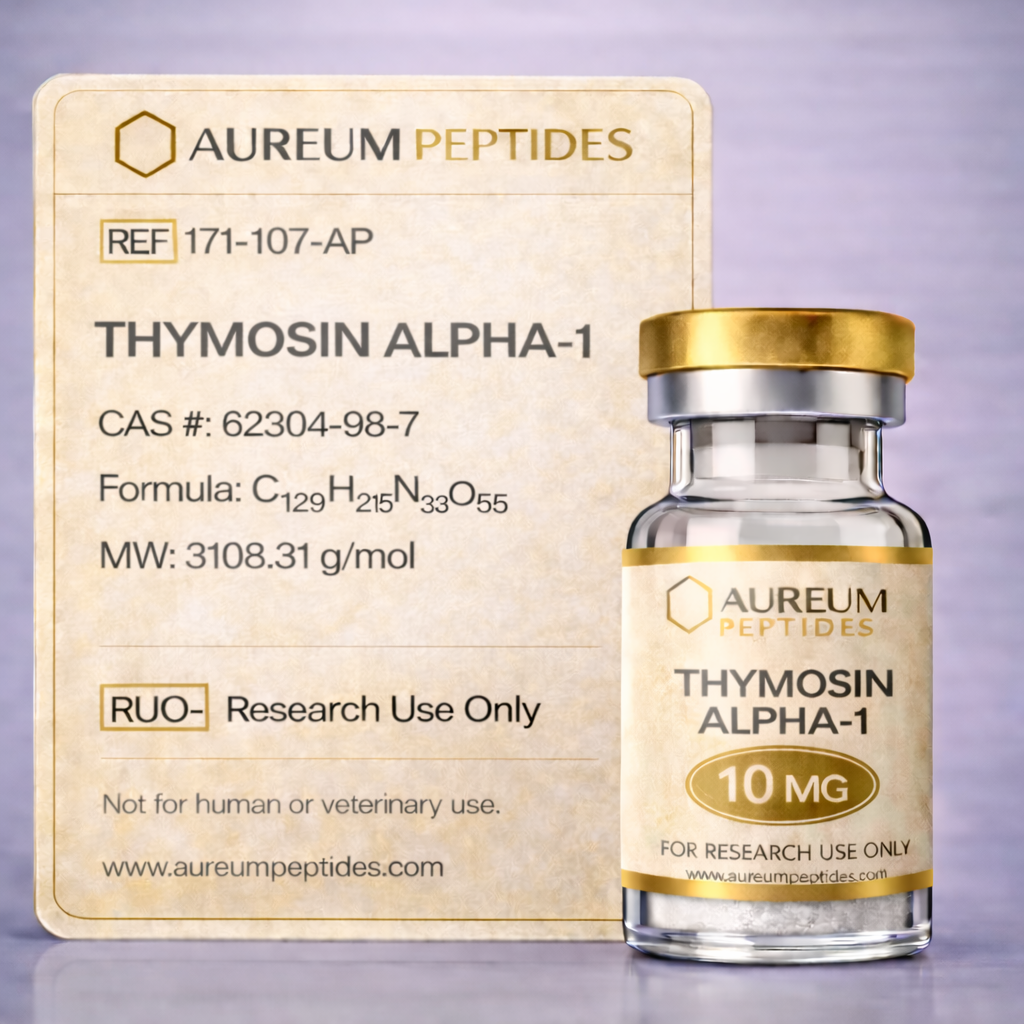
Thymosin Alpha-1
Tα1, T-alpha-1, Thymalfasin, Zadaxin, Thymosin α1, TP-1, TMSA, Acetyl-Ser-Asp-Ala-Ala-Val-Asp-Thr-Ser-Ser-Glu-Ile-Thr-Thr-Lys-Asp-Leu-Lys-Glu-Lys-Lys-Glu-Val-Val-Glu-Glu-Ala-Glu-Asn

Quality & Transparency
Every batch tested. Every result published. No exceptions.
Thymosin alpha-1 (Tα1) is a naturally occurring thymic peptide originally isolated from thymosin fraction 5, a preparation derived from bovine thymus tissue. This 28-amino acid acetylated polypeptide represents a cleavage product of prothymosin alpha and functions as an endogenous immunomodulatory agent. Classified as a biological response modifier peptide, Tα1 has garnered significant interest in laboratory research for its role in immune system regulation, particularly in T-cell differentiation, maturation, and functional activation. Preclinical studies suggest involvement in both innate and adaptive immune responses, making it a valuable research tool for investigating immunological mechanisms. In vitro and in vivo models indicate that Tα1 may influence cytokine production, dendritic cell maturation, and T-lymphocyte receptor expression. Its well-characterized sequence and documented immunoregulatory properties position thymosin alpha-1 as a critical reagent in immunology research, vaccine development studies, and investigations into host defense mechanisms against infectious agents and malignant cell proliferation.
Thymosin alpha-1 is a 28-amino acid peptide with the sequence: Ac-Ser-Asp-Ala-Ala-Val-Asp-Thr-Ser-Ser-Glu-Ile-Thr-Thr-Lys-Asp-Leu-Lys-Glu-Lys-Lys-Glu-Val-Val-Glu-Glu-Ala-Glu-Asn-OH. The peptide features N-terminal acetylation at the serine residue, a post-translational modification critical for biological activity and structural stability. With a molecular weight of approximately 3,108 Daltons and an isoelectric point near 4.2, Tα1 exhibits a predominantly acidic character due to its high proportion of aspartate and glutamate residues. Structurally, the peptide demonstrates significant conformational flexibility in aqueous solution, though it adopts more ordered secondary structures in membrane-mimetic environments. Tα1 interacts with various cellular targets, including Toll-like receptors (TLRs) and interferon regulatory pathways, though a single high-affinity receptor has not been definitively characterized. The peptide demonstrates relative stability under physiological conditions, with susceptibility to proteolytic degradation mitigated by its acetylated N-terminus and compact structure. Lyophilized preparations maintain biochemical integrity under appropriate storage conditions, supporting reproducible experimental outcomes in laboratory research applications.
Thymosin alpha-1 serves as a valuable research reagent for investigating immune system modulation, particularly in understanding the molecular mechanisms underlying T-lymphocyte development and function. In preclinical research models, Tα1 has been employed to examine host defense responses, cytokine network regulation, and cellular immune activation pathways. The peptide's documented effects on dendritic cell maturation and antigen presentation make it relevant for vaccine adjuvant research and immunotherapeutic strategy development in laboratory settings.
- T-cell differentiation and maturation studies using flow cytometry and immunophenotyping assays to assess CD4+ and CD8+ populations
- Cytokine gene expression profiling experiments examining IL-2, IFN-γ, TNF-α, and other immune mediator transcripts via qRT-PCR and ELISA methodologies
- Dendritic cell maturation and co-stimulatory molecule expression analysis (CD80, CD86, MHC-II) in vitro
- Toll-like receptor signaling pathway investigations, particularly TLR-2 and TLR-9 activation cascades using reporter assays and Western blotting
- Natural killer (NK) cell functional assays measuring cytotoxicity, perforin/granzyme expression, and activation marker upregulation
- In vivo immunization models examining antibody responses and cellular immunity in rodent research systems
- Oxidative stress and mitochondrial function studies in immune cell populations under various experimental conditions
At the molecular level, thymosin alpha-1 influences multiple signaling cascades involved in immune cell activation and differentiation. Research observations indicate that Tα1 modulates Toll-like receptor pathways, particularly TLR-2 and TLR-9, leading to downstream activation of nuclear factor kappa-B (NF-κB) and interferon regulatory factors (IRFs). These transcription factors subsequently promote expression of pro-inflammatory cytokines, type I interferons, and chemokines in preclinical models. In vitro studies using dendritic cells demonstrate that Tα1 exposure correlates with upregulation of co-stimulatory molecules CD80 and CD86, enhancing antigen presentation capacity and T-cell priming efficiency. The peptide has been observed to influence the JAK-STAT signaling pathway, particularly STAT1 and STAT4 phosphorylation, which mediate interferon-gamma responses and Th1 polarization in laboratory research systems.
Additional mechanistic investigations reveal that thymosin alpha-1 may affect intracellular calcium mobilization and protein kinase C activation in lymphocytes, contributing to altered gene transcription profiles. Preclinical data suggest involvement in the PI3K/Akt pathway, which regulates cell survival signals and metabolic reprogramming in activated immune cells. Research using T-cell cultures indicates that Tα1 promotes IL-2 receptor alpha chain (CD25) expression, enhancing responsiveness to autocrine and paracrine IL-2 signaling. Furthermore, in vivo studies employing immunocompromised rodent models have documented effects on thymic reconstitution and peripheral T-cell expansion, suggesting involvement in lymphopoietic regulatory mechanisms. Gene array analyses in experimental systems reveal modulation of apoptosis-related genes, including upregulation of anti-apoptotic factors such as Bcl-2 family members, providing molecular context for observed effects on lymphocyte survival in research conditions.
Extensive preclinical investigations have characterized thymosin alpha-1's immunomodulatory properties across diverse experimental paradigms. In murine models of immune suppression, including cyclophosphamide-treated and aged animal cohorts, Tα1 administration has been associated with restoration of T-lymphocyte populations, enhanced delayed-type hypersensitivity responses, and improved mitogen-induced proliferation in ex vivo splenocyte cultures. Rodent vaccination studies demonstrate that Tα1 co-administration with various antigens correlates with augmented antibody titers and enhanced CD8+ cytotoxic T-lymphocyte responses, supporting its investigation as a potential immunological adjuvant in research settings. In vitro experiments using human peripheral blood mononuclear cells (PBMCs) reveal dose-dependent increases in IFN-γ production, NK cell cytotoxicity, and T-cell receptor signaling activation following Tα1 exposure.
Cell culture investigations employing dendritic cell lines and primary antigen-presenting cells indicate that Tα1 promotes maturation markers including MHC class II, CD40, and CD86 expression, alongside enhanced IL-12 secretion profiles. Research using viral infection models in mice, including influenza and hepatitis B virus systems, documents associations between Tα1 treatment and reduced viral load, increased virus-specific antibody responses, and enhanced survival rates compared to control groups. These observations correlate with elevated splenic CD4+ and CD8+ T-cell frequencies and increased IFN-γ+ lymphocyte populations detected by intracellular cytokine staining. Additional preclinical work in tumor-bearing rodent models has examined immune cell infiltration into tumor microenvironments, with flow cytometry data indicating altered ratios of effector T-cells to regulatory T-cells in Tα1-treated experimental groups. Mechanistic studies at the molecular level demonstrate that Tα1 influences mitochondrial membrane potential and reduces oxidative stress markers in immune cells subjected to various stressors in laboratory conditions, providing insight into potential cytoprotective mechanisms relevant to immune function research.
Thymosin alpha-1 research peptide is supplied as a sterile, lyophilized powder in individually sealed vials, optimized for stability during storage and reconstitution flexibility in laboratory workflows. Each production batch undergoes rigorous analytical verification to ensure consistency and quality for research applications. High-performance liquid chromatography (HPLC) analysis confirms peptide purity ≥98%, with gradient elution profiles establishing the absence of significant truncation products or aggregates. Mass spectrometry (MS) provides definitive molecular weight confirmation and sequence identity verification, ensuring the supplied peptide matches the expected 28-amino acid structure with N-terminal acetylation. Endotoxin testing via Limulus Amebocyte Lysate (LAL) assay confirms levels <1.0 EU/mg, critical for in vitro cell culture applications and in vivo research models where endotoxin contamination could confound immunological readouts. Certificates of Analysis (COA) are available for each lot, documenting analytical results and supporting experimental reproducibility across research protocols.
- 1Goldstein AL et al., Annals of the New York Academy of Sciences, 2007 1112:1-13. PubMed
- 2Garaci E et al., Annals of the New York Academy of Sciences, 2007 1112:225-234. PubMed
- 3Matteucci C et al., Expert Opinion on Biological Therapy, 2017 17(12):1501-1508. PubMed
- 4King R et al., International Immunopharmacology, 2001 1(3):501-508. PubMed
- 5Sherman KE et al., Journal of Viral Hepatitis, 1998 5(3):195-199. PubMed
- 6Wu MY et al., International Immunopharmacology, 2019 77:105958. PubMed
- 7Zhao B et al., Pharmacological Research, 2016 105:1-6. PubMed
- 8Baumann CA et al., Immunopharmacology and Immunotoxicology, 1997 19(4):445-467. PubMed
- 9Skotnicki AB et al., Cancer Immunology, Immunotherapy, 1993 37(1):1-7. PubMed
- 10Romagnani S, Immunology Today, 2000 21(10):479-483. PubMed
- 11Singh VK et al., Journal of Biological Response Modifiers, 1984 3(5):514-520. PubMed
- 12Shrivastava P et al., International Immunopharmacology, 2006 6(10):1504-1514. PubMed
Advancing Research, One Peptide at a Time
Premium quality. Rigorous testing. Trusted by researchers worldwide.

Third-party testing data will be displayed here once available.
Temperature
Lyophilized: -20°C
Reconstituted: 2-8°C (30 days)
Shelf Life
24 months lyophilized
30 days reconstituted
Handling
Avoid freeze-thaw cycles.
Use bacteriostatic water for reconstitution.
Frequently Asked Questions
Stay at the Forefront
Join our research community. Get early access to new peptides, exclusive member pricing, and curated literature reviews delivered to your inbox.
Welcome to the Circle ✦
Check your inbox for your 10% welcome discount
Related Peptides
Explore complementary research compounds