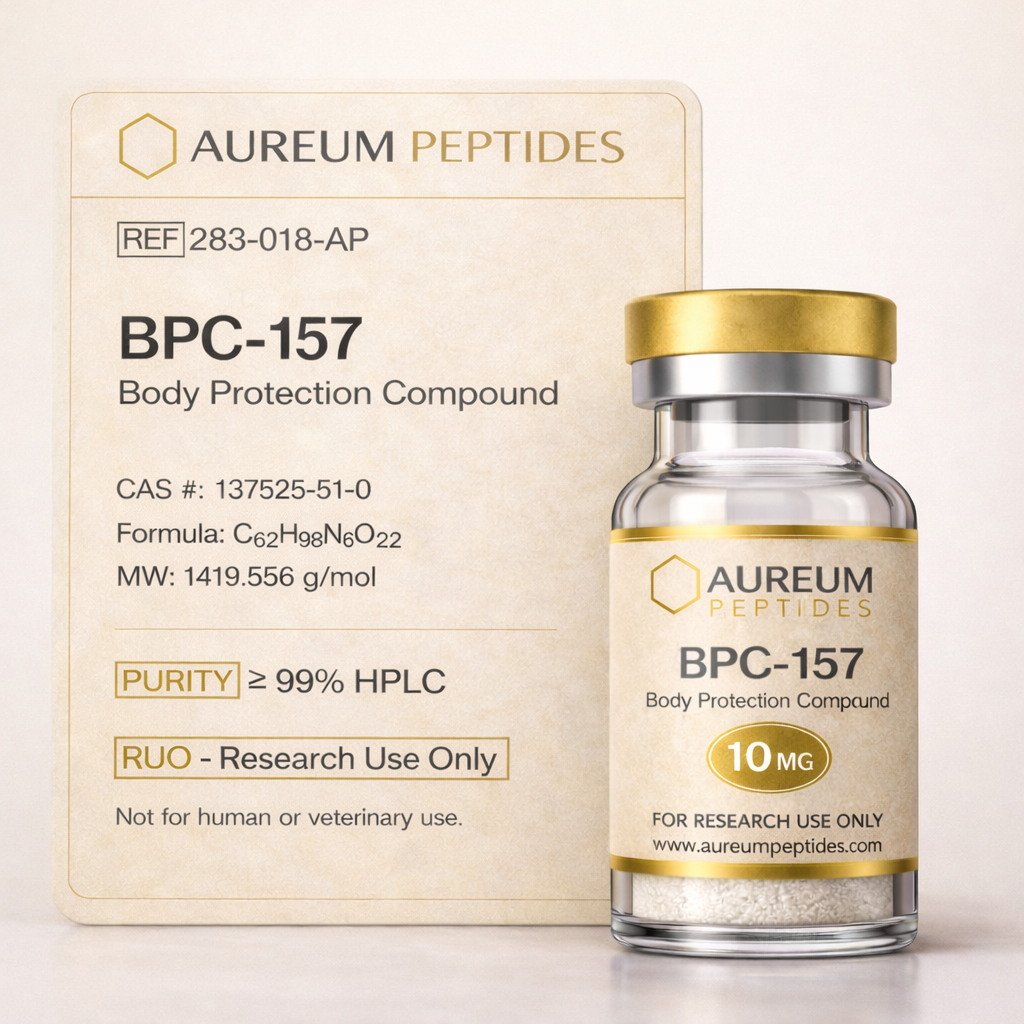
BPC-157
BPC 157, BPC-15, Body Protection Compound-157, Body Protective Compound 15, PL 14736, PL-10, Pentadecapeptide BPC 157, Bepecin, H-Gly-Glu-Pro-Pro-Pro-Gly-Lys-Pro-Ala-Asp-Asp-Ala-Gly-Leu-Val-OH

Quality & Transparency
Every batch tested. Every result published. No exceptions.
BPC-157 is a synthetic pentadecapeptide derived from a protective peptide sequence found in human gastric juice. Designated as Body Protection Compound-157, this 15-amino acid peptide represents a partial sequence of the naturally occurring body protection compound (BPC) discovered in gastric secretions. As a stable gastric pentadecapeptide, BPC-157 has garnered significant attention in preclinical research for its potential cytoprotective properties observed across multiple organ systems in laboratory models. The compound has been extensively investigated in in vitro cell culture systems and in vivo rodent models examining tissue repair mechanisms, angiogenic signaling pathways, and cellular protection under various experimental injury conditions. Research interest centers on its interactions with growth factor signaling cascades, nitric oxide pathways, and vascular endothelial growth factor (VEGF) systems. BPC-157 exhibits remarkable stability in gastric acid environments and demonstrates systemic effects following various routes of administration in laboratory animals, making it a versatile tool for mechanistic studies of tissue homeostasis and regenerative biology at the molecular level.
BPC-157 is a pentadecapeptide with the amino acid sequence Gly-Glu-Pro-Pro-Pro-Gly-Lys-Pro-Ala-Asp-Asp-Ala-Gly-Leu-Val, corresponding to a partial sequence of human gastric BPC. With a molecular weight of approximately 1419 Da, this peptide contains multiple proline residues that contribute to its conformational stability. The tripeptide proline sequence (Pro-Pro-Pro) is particularly notable for conferring resistance to enzymatic degradation. BPC-157 demonstrates exceptional stability in gastric acid, remaining intact at pH 2.0, and shows resistance to degradation by digestive enzymes including pepsin. The peptide does not exhibit binding to specific characterized receptor systems in conventional receptor-ligand assays, suggesting its mechanisms may involve modulation of multiple signaling pathways rather than direct receptor activation. Structural analysis indicates the compound maintains stability across a wide temperature range and resists degradation in biological matrices for extended periods. This stability profile makes BPC-157 particularly suitable for prolonged in vitro studies and diverse experimental protocols requiring consistent peptide integrity throughout observation periods.
BPC-157 serves as a valuable research tool in preclinical investigations of tissue repair mechanisms, cellular protection pathways, and angiogenic signaling cascades. Its stability and multi-system effects in laboratory models have positioned it as a compound of interest for elucidating molecular mechanisms underlying tissue homeostasis and regenerative responses to experimental injury. Researchers utilize this peptide to probe interactions between growth factor signaling, nitric oxide pathways, and vascular remodeling processes in controlled laboratory settings.
- Angiogenesis assays examining VEGF receptor expression, endothelial cell migration, and vessel formation in in vitro models
- Wound healing studies measuring fibroblast proliferation, collagen deposition, and epithelial migration in cell culture systems
- Nitric oxide synthase pathway investigations assessing NOS enzyme expression and NO production in various cell types
- Cytoprotection experiments evaluating cellular survival, apoptosis markers, and stress response protein expression under oxidative or chemical stress conditions
- Gene expression profiling studies examining growth factor, cytokine, and extracellular matrix component mRNA levels following peptide exposure
- Tissue repair model systems in rodents examining molecular markers of regeneration, inflammation modulation, and structural remodeling
- Signaling pathway analysis investigating FAK, Akt, ERK, and other kinase activation patterns in response to peptide administration
In laboratory research models, BPC-157 has been associated with modulation of several key molecular signaling pathways involved in tissue homeostasis and cellular protection. Preclinical studies indicate the peptide influences nitric oxide (NO) pathways through interactions with nitric oxide synthase (NOS) enzyme systems. Research in rodent models suggests BPC-157 may modulate the balance between constitutive NOS isoforms (eNOS, nNOS) and inducible NOS (iNOS), though the precise molecular mechanisms remain under investigation. In vitro studies have demonstrated alterations in NO production in endothelial cells and other cell types following peptide exposure, with implications for vascular tone regulation and cellular signaling.
Angiogenic signaling represents another extensively studied pathway context for BPC-157 research. Laboratory investigations indicate the peptide influences vascular endothelial growth factor (VEGF) system components, including VEGF receptor expression and downstream signaling cascades. In endothelial cell models, researchers have observed alterations in VEGFR2 phosphorylation patterns and activation of associated kinases including FAK (focal adhesion kinase), Akt, and ERK1/2 following BPC-157 exposure. These signaling events are associated with endothelial cell migration, proliferation, and tube formation in in vitro angiogenesis assays. Additionally, studies suggest interactions with the EGF (epidermal growth factor) signaling pathway and its receptor EGFR, particularly in models examining epithelial cell responses.
Further mechanistic research has explored BPC-157's influence on inflammatory signaling networks and cytoprotective pathways. In various experimental injury models, the peptide has been associated with altered expression of inflammatory cytokines including TNF-α, IL-6, and IL-1β, suggesting modulation of NF-κB and related transcription factor activity. Studies also indicate potential interactions with heat shock protein expression, antioxidant enzyme systems including superoxide dismutase and catalase, and cellular survival signaling through Akt and related kinases.
Extensive preclinical research has investigated BPC-157 across diverse experimental models examining tissue injury, repair mechanisms, and cellular protection. In rodent models of gastric injury induced by ethanol, NSAIDs, or stress, administration of BPC-157 has been associated with reduced lesion formation, accelerated healing rates, and preservation of mucosal integrity markers. Histological analyses in these models reveal maintained epithelial architecture, reduced inflammatory cell infiltration, and preserved microvascular structures compared to injury controls. Molecular assessments demonstrate altered expression of cytoprotective proteins, growth factors, and inflammatory mediators in gastric tissue following peptide administration.
Musculoskeletal injury models have constituted another major research focus. In experimental tendon injury models in rats, BPC-157 administration has been associated with accelerated healing timelines, improved biomechanical properties, and enhanced cellular organization within repair tissue. Gene expression analyses reveal upregulation of collagen genes, growth factors including VEGF and TGF-β, and extracellular matrix remodeling enzymes. Similar observations have been reported in models of muscle injury, ligament damage, and bone healing, where the peptide has been associated with enhanced expression of regenerative markers and structural protein deposition. Immunohistochemical studies demonstrate increased angiogenic markers, proliferation indices, and growth factor receptor expression in healing tissues.
Vascular system investigations have revealed effects on endothelial function and vessel formation in laboratory models. In ischemia models and vascular injury protocols, BPC-157 administration has been associated with enhanced collateral vessel formation, improved blood flow parameters, and increased endothelial cell proliferation markers. In vitro angiogenesis assays demonstrate enhanced endothelial tube formation, increased cell migration in scratch assays, and elevated VEGF signaling pathway activation. These molecular-level observations provide mechanistic context for understanding the peptide's influence on vascular remodeling processes in experimental systems.
BPC-157 is supplied as a sterile, lyophilized powder in sealed vials for research use only. Each batch undergoes comprehensive analytical verification to ensure consistency and quality for laboratory applications. High-Performance Liquid Chromatography (HPLC) analysis confirms peptide purity, with specifications typically exceeding 98% purity. Mass spectrometry (MS) verification confirms molecular identity and sequence integrity, ensuring the correct pentadecapeptide structure. Endotoxin testing is performed using Limulus Amebocyte Lysate (LAL) assay methodology to verify levels suitable for cell culture and in vivo research applications. The lyophilized form provides enhanced stability for storage and allows researchers to reconstitute the peptide in appropriate buffers for specific experimental protocols. A Certificate of Analysis (COA) accompanies each batch, documenting HPLC purity profiles, mass spectrometry data, and endotoxin levels. These analytical verification methods support reproducibility and consistency in laboratory workflows, enabling reliable experimental outcomes across diverse research applications.
- 1Sikiric P et al., J Physiol Paris, 1993 87(5):313-327. PubMed
- 2Sikiric P et al., Dig Dis Sci, 1996 41(8):1604-1614. PubMed
- 3Seiwerth S et al., J Physiol Paris, 1997 91(3-5):113-122. PubMed
- 4Sikiric P et al., J Physiol Paris, 2000 94(1):43-48. PubMed
- 5Staresinic M et al., J Physiol Pharmacol, 2006 57(Suppl 7):115-124. PubMed
- 6Gwyer D et al., Drug Des Devel Ther, 2016 10:627-637. PubMed
- 7Chang CH et al., Regul Pept, 2011 167(2-3):217-221. PubMed
- 8Chang CH et al., J Orthop Res, 2014 32(11):1514-1522. PubMed
- 9Sikiric P et al., Curr Pharm Des, 2018 24(18):1990-2001. PubMed
- 10Vukojević J et al., Front Pharmacol, 2018 9:306. PubMed
- 11Sebečić B et al., J Orthop Res, 1999 17(4):560-569. PubMed
- 12Tkalčević VI et al., EBioMedicine, 2007 24:181-182. PubMed
Advancing Research, One Peptide at a Time
Premium quality. Rigorous testing. Trusted by researchers worldwide.

Third-party testing data will be displayed here once available.
Temperature
Lyophilized: -20°C
Reconstituted: 2-8°C (30 days)
Shelf Life
24 months lyophilized
30 days reconstituted
Handling
Avoid freeze-thaw cycles.
Use bacteriostatic water for reconstitution.
Frequently Asked Questions
Stay at the Forefront
Join our research community. Get early access to new peptides, exclusive member pricing, and curated literature reviews delivered to your inbox.
Welcome to the Circle ✦
Check your inbox for your 10% welcome discount
Related Peptides
Explore complementary research compounds