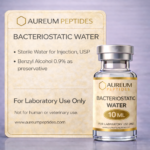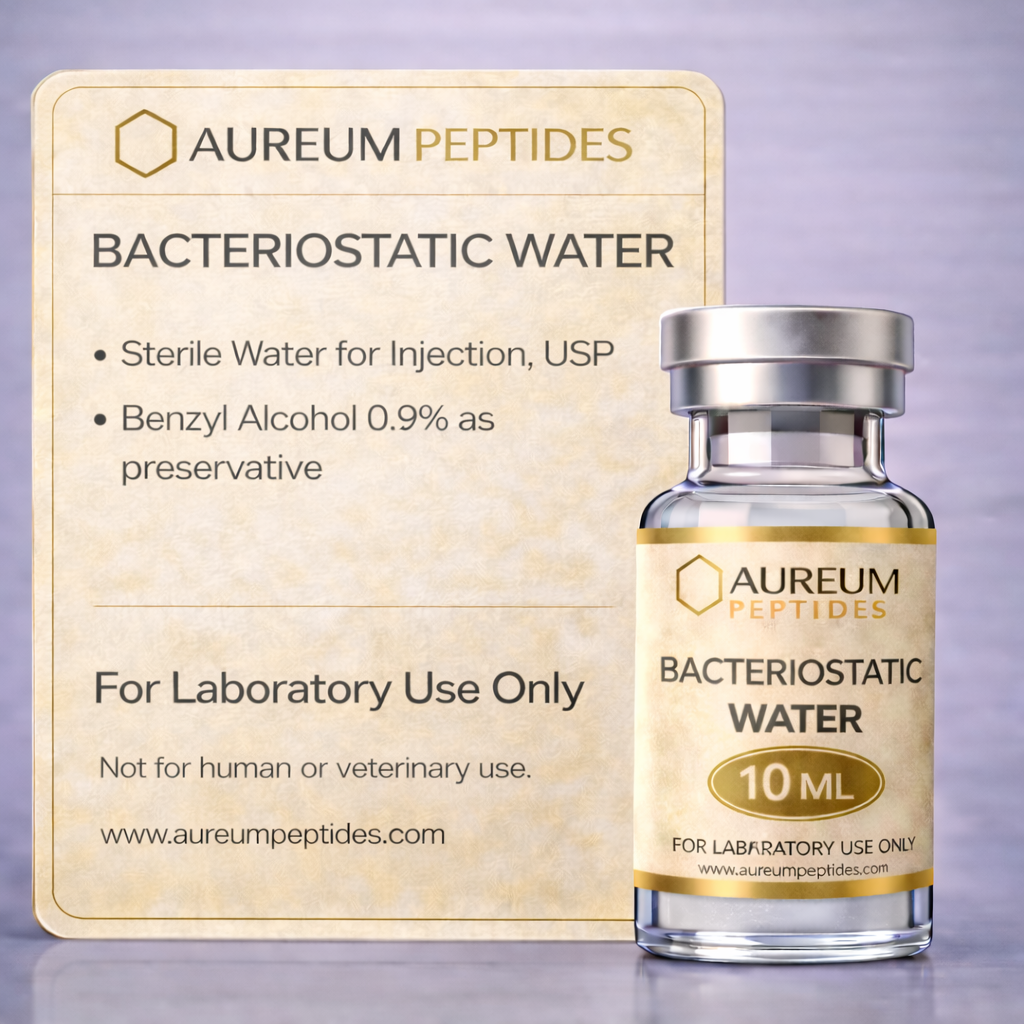
Bacteriostatic water
Bacteriostatic Water for Injection, BAC Water, BWFI, Bacteriostatic Saline, Preserved Sterile Water, 0.9% Benzyl Alcohol Water

Quality & Transparency
Every batch tested. Every result published. No exceptions.
Bacteriostatic water is a sterile water preparation containing 0.9% benzyl alcohol as a preservative, designed to inhibit bacterial growth in multi-use vials during extended research protocols. This pharmaceutical-grade solvent serves as a critical reconstitution medium for lyophilized peptides, proteins, and other biomolecules in laboratory settings. Unlike sterile water for injection, which is preservative-free and intended for single use, bacteriostatic water maintains sterility through multiple needle punctures over extended periods when stored under appropriate conditions. The benzyl alcohol component exerts antimicrobial action against a broad spectrum of gram-positive and gram-negative bacteria, making it particularly valuable for research applications requiring serial reconstitutions or aliquoting procedures. In preclinical research environments, bacteriostatic water is employed extensively for preparing working solutions of peptide standards, reconstituting lyophilized research compounds, and diluting stock solutions for in vitro and in vivo experimental models. Its widespread adoption in research laboratories stems from documented stability characteristics and consistent performance across diverse experimental protocols requiring preserved aqueous vehicles.
Bacteriostatic water consists of sterile water (H₂O) containing 0.9% (9 mg/mL) benzyl alcohol (C₇H₈O) as a bacteriostatic preservative agent. The benzyl alcohol molecule features an aromatic ring structure with a hydroxymethyl substituent, providing both hydrophobic and hydrophilic characteristics that facilitate membrane disruption in bacterial cells. The preservative concentration is optimized to provide antimicrobial efficacy while maintaining biocompatibility with most peptide and protein structures. Benzyl alcohol's mechanism involves disruption of bacterial cell membrane integrity and inhibition of enzymatic pathways essential for microbial metabolism. The solution maintains a neutral pH range (4.5-7.0) compatible with most research peptides, minimizing pH-induced structural alterations during reconstitution. Stability studies indicate bacteriostatic water retains antimicrobial efficacy for 28 days following initial vial puncture when stored at 2-8°C, though specific stability may vary based on storage conditions and handling protocols. The absence of buffering agents or additional solutes makes this vehicle particularly suitable for applications requiring minimal formulation complexity and maximum compatibility with diverse peptide sequences and post-translational modifications.
Bacteriostatic water serves as an essential research tool in peptide science, biochemistry, and molecular pharmacology laboratories, providing a standardized vehicle for reconstitution and dilution procedures. Its antimicrobial preservation properties enable consistent experimental workflows across multi-day protocols and serial sampling designs. Research applications span fundamental biochemical characterization through complex in vivo experimental models.
- Reconstitution of lyophilized peptides, proteins, and small molecules for stock solution preparation in preclinical studies
- Serial dilution procedures for dose-response curve generation in cell-based assays and receptor binding experiments
- Vehicle preparation for subcutaneous, intraperitoneal, and intramuscular administration routes in rodent pharmacokinetic studies
- Standard curve preparation for immunoassays, ELISA protocols, and quantitative mass spectrometry applications
- Diluent for peptide stability studies examining degradation kinetics under various storage conditions
- Reconstitution medium for peptide library screening in high-throughput biochemical assays
- Vehicle control preparation in comparative studies evaluating formulation effects on peptide bioavailability and pharmacodynamics
While bacteriostatic water itself does not directly modulate cellular signaling pathways, its role as a vehicle significantly influences experimental outcomes through effects on peptide stability, solubility, and bioavailability in research models. The benzyl alcohol preservative component has been examined in preclinical studies for potential interactions with biological systems. Research indicates benzyl alcohol undergoes rapid oxidation to benzoic acid via alcohol dehydrogenase enzymes in hepatic tissue, subsequently conjugating with glycine to form hippuric acid for renal elimination. At concentrations used in bacteriostatic water formulations, benzyl alcohol demonstrates minimal interference with common cellular signaling cascades in standard experimental protocols.
Investigation of vehicle effects in pharmacological research has revealed that reconstitution medium composition can influence peptide aggregation states, conformational stability, and receptor interaction kinetics. Studies comparing bacteriostatic water to alternative reconstitution vehicles have documented differences in peptide solubility profiles, particularly for hydrophobic sequences prone to aggregation. The preservative-containing formulation has shown utility in maintaining peptide integrity during storage intervals between experimental timepoints, reducing variability attributed to degradation or microbial contamination in multi-use vial scenarios.
In the context of in vivo research models, vehicle selection impacts subcutaneous depot formation, tissue distribution kinetics, and local inflammatory responses at injection sites. Preclinical comparative studies have examined tissue responses to various injection vehicles, with benzyl alcohol-containing formulations demonstrating distinct pharmacokinetic profiles compared to preservative-free alternatives. These observations emphasize the importance of consistent vehicle use across experimental replicates and appropriate vehicle control groups in research designs investigating peptide pharmacology and mechanism of action studies.
Extensive preclinical research has characterized the antimicrobial efficacy and preservative properties of benzyl alcohol in aqueous formulations. Microbiological challenge studies have demonstrated that 0.9% benzyl alcohol effectively inhibits growth of Staphylococcus aureus, Pseudomonas aeruginosa, Escherichia coli, and Candida albicans in multi-dose vial systems over 28-day test periods. These antimicrobial properties derive from benzyl alcohol's ability to disrupt bacterial cell membrane integrity and interfere with essential metabolic processes. Time-kill kinetic studies indicate concentration-dependent bacteriostatic activity, with 0.9% concentrations providing optimal preservation without compromising compatibility with most peptide structures.
Preclinical toxicology studies in rodent models have established safety profiles for benzyl alcohol at concentrations used in bacteriostatic water formulations. Repeated-dose studies in rats and mice receiving subcutaneous injections of benzyl alcohol-preserved vehicles have characterized dose-response relationships for local tissue effects and systemic exposure markers. Histopathological examination of injection sites has documented mild, transient inflammatory responses that resolve without intervention in standard experimental protocols. Metabolic studies using radiolabeled benzyl alcohol have traced conversion pathways through hepatic oxidation and subsequent glycine conjugation, with hippuric acid as the primary urinary metabolite in rodent models.
Comparative pharmacokinetic studies have evaluated vehicle effects on peptide bioavailability and tissue distribution in laboratory animals. Research using model peptides reconstituted in bacteriostatic water versus alternative vehicles has identified formulation-dependent differences in absorption rates, peak plasma concentrations, and elimination half-lives following subcutaneous administration in rats. These findings underscore the importance of vehicle consistency in experimental designs and highlight the role of reconstitution medium as a critical variable in peptide pharmacology research. Additional studies examining peptide stability in bacteriostatic water have documented preservation of biological activity over storage intervals relevant to multi-day experimental protocols.
Bacteriostatic water is supplied as a sterile, clear, colorless solution in multi-use vials sealed under aseptic conditions following pharmaceutical manufacturing standards. Each lot undergoes comprehensive analytical verification to ensure compliance with research-grade specifications. Sterility testing follows USP methodology, confirming absence of viable microorganisms through direct inoculation and enrichment culture techniques. Benzyl alcohol content is quantified using high-performance liquid chromatography (HPLC) with UV detection, verifying preservative concentration at 0.9% ± 0.1%. Endotoxin levels are assessed via Limulus Amebocyte Lysate (LAL) assay, confirming values below detection thresholds appropriate for research applications. pH measurement confirms neutral range compatibility. Container closure integrity testing validates septum performance through multiple puncture cycles. Certificates of Analysis (COA) accompany each lot, documenting these analytical parameters and supporting experimental reproducibility. These quality control measures ensure consistent vehicle performance across diverse laboratory workflows and enable standardized reconstitution procedures essential for rigorous preclinical research protocols.
- 1Shehata M et al., Journal of Pharmaceutical Sciences, 1983 72(11):1290-1293. PubMed
- 2Wilson CO et al., American Journal of Health-System Pharmacy, 1975 32(10):1032-1034. PubMed
- 3Kahan JS et al., American Journal of Hospital Pharmacy, 1981 38(8):1167-1170. PubMed
- 4Jones RN et al., Antimicrobial Agents and Chemotherapy, 1985 27(4):574-576. PubMed
- 5Fowler JF et al., Contact Dermatitis, 2001 45(5):289-291. PubMed
- 6Nordberg A et al., Drug Metabolism and Disposition, 1974 2(5):411-418. PubMed
- 7Gershanik J et al., New England Journal of Medicine, 1982 307(23):1384-1388. PubMed
- 8Krasner J et al., Journal of Toxicology and Environmental Health, 1992 35(4):269-277. PubMed
- 9Mathur LK et al., Archives of Toxicology, 1977 38(2):137-141. PubMed
- 10Brooks BM et al., PDA Journal of Pharmaceutical Science and Technology, 2004 58(4):193-204. PubMed
- 11Grant DJW et al., International Journal of Pharmaceutics, 1984 18(1-2):25-38. PubMed
Advancing Research, One Peptide at a Time
Premium quality. Rigorous testing. Trusted by researchers worldwide.
Third-party testing data will be displayed here once available.
Temperature
Lyophilized: -20°C
Reconstituted: 2-8°C (30 days)
Shelf Life
24 months lyophilized
30 days reconstituted
Handling
Avoid freeze-thaw cycles.
Use bacteriostatic water for reconstitution.
Frequently Asked Questions
Stay at the Forefront
Join our research community. Get early access to new peptides, exclusive member pricing, and curated literature reviews delivered to your inbox.
Welcome to the Circle ✦
Check your inbox for your 10% welcome discount
Related Peptides
Explore complementary research compounds